I read a fairy tale once
one with courts of creatures vying for
the biggest slice of mortal pie
trying to outdo each other left and right
at how best to use a human being for play
there was a queen and her sister
opposites in every way
she was the birthplace of order
of straight lines and rules
and her sister was a hot mess personified
sometimes I feel like the sister
reveling in the chaos birthed by my mere presence
but usually I just want peace and quiet
and calm seas
most days
I’m the queen with all her inherent control
almost inflexible with it
if I were a fairy
I’d be the one granting wishes
exactly
as they’re worded
twisting dreams into nightmares for fun
Category: [witchcraft & wonder]
anything related to witchcraft, magick, spirituality, and philosophy
no need for humans [poem]
I can spend
up to 12 hours without human interaction
before I start to fidget
24 hours
before the need to see other humans
outweighs the desire to be left alone at home
it was easier when I had friends
people with varied schedules that led to
at least one somebody being available
at any given time
it was easier when there were
familiar haunting grounds
places I could enter with strangers
soaking up the energies of
being around other people
without having to be with other people directly
some days
I feel like an introverted energy vampire
with social anxiety
like this need for humans is based on instinct
rather than interest
like I’d gladly avoid other humans completely
if I wouldn’t starve a day later
tick tock [poem]
they waited so patiently for me
the tick tock of time held little meaning
as they watched for the sign
proof that I was finally ready to heed their call again
the gods choose their vessels of sacred love
with an eye on permanence
my soul has always been marked for this
guiding and teaching
and growing new seeds of witchcraft
in my wake
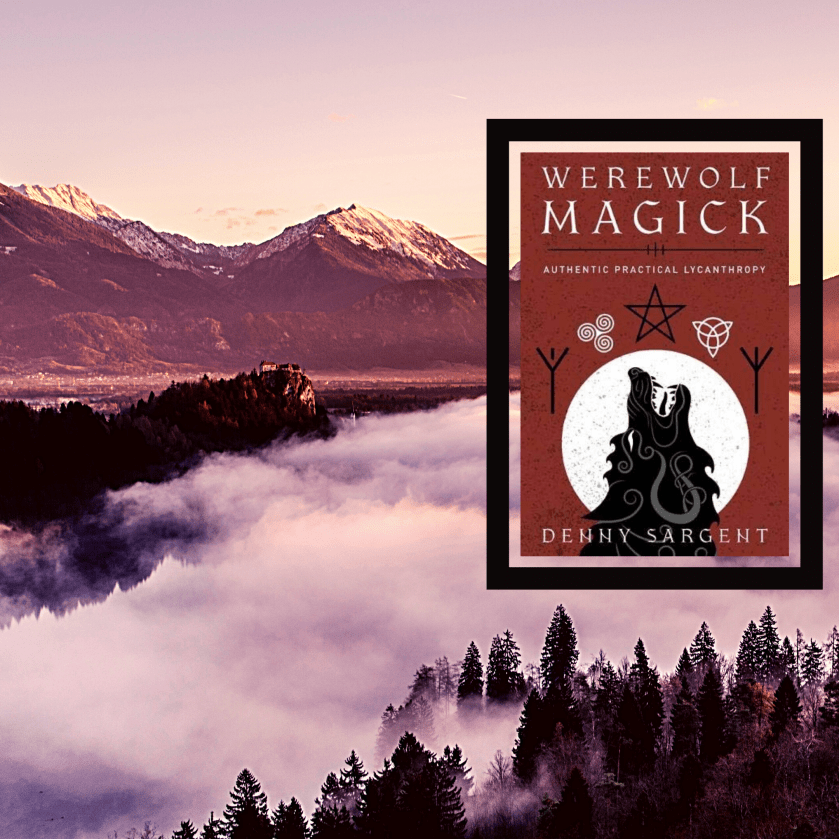
[Witchy Review] “Werewolf Magick” by Denny Sargent
Full Title: Werewolf Magick: Authentic Practical Lycanthropy
Author: Denny Sargent
Published: September 2020 by Llewellyn Publications
Genres: Nonfiction, Magic Studies, Witchcraft
Edition Details: 240 pages, trade paperback
Source: ARC – Requested by me
Rating: {2.5/5 stars}
First Glance
As a therian and animist, I enjoy any opportunity to delve into magic related to shapeshifting and spirit work. This book clearly focused on wolves, which happen to be one of my favorite animals, so I decided to ask for a first look. I received an advanced readers’ copy (ebook) through NetGalley. As usual, I get paid nothing to give my honest opinion.
Positive Bits
The overall idea behind werewolf magick is that we need to (and can) embrace our wild side and go a little feral if we want to really connect to our own power. I’ve written and participated in several different versions of this kind of magic, where you reach deep down to find your inner wildness; it’s a powerful piece of energy work.
The author clearly runs with this wildness, as the majority of the rituals included are wordless. Howls and yips and growls are the only magical words used, and I think that’s a smart approach. It makes it a little harder to plan your ritual, as there are no cue cards, but sound is a good carrier of energy regardless of its form.
I appreciated the notes on animal parts and meat usage throughout the book. As someone who prefers to be an ethical omnivore rather than a vegetarian, I respect the balancing act it takes to honor the animals who obviously had to die in order for you to eat or wear them. There are different ways to approach animal parts (fur, bones, or meat) and they all start with an acknowledgement of death and your role in the process.
Less Enjoyable Bits
I’ll admit that this book is too eclectic for me. There are repeated notices that the author makes no claim at being a shaman, which is all well and good. But then there are random pieces of the Greco-Roman pantheon, modernized versions of old Nordic ritual, and a surprise visit from an Egyptian god. Throughout that mix, we have Gaia used as a name for the Earth as a being (but not as Gaia, the Greco-Roman goddess) and a liberal smattering of mantras from Hindu practices (without any explanation about their source or purpose). The author could’ve used a bit more explanation between rituals to tie together his eclectic pieces, but they were presented as disjointed mosaic pieces.
In the history of werewolves presented, the author travels a familiar and well-worn path of pretending that witches (and, therefore, werewolves) have always existed and were hunted down during the Burning Times. And yet, enough witches and werewolves hid to bring their practices to us today. The truth is, we’ve recognized as a community that the “history” we were taught was a tool to loan authenticity to new practices. After all, everyone respects an ancient teaching, right? Each example of werewolves in the past is dubiously tied together in a string, and it’s supposed to guide us from ancient werewolves to today’s shifters in an unbroken line… that I’m not buying.
Based on personal studies and experience, I found his entire section on Fetches to be misguided. Take it or leave it as you will, but I find that a Fetch or similar thoughtform isn’t an alter ego (wolf or otherwise) of myself. Rather, it’s a separate and directed entity. The author treats the animalself (his word for your animal side) as both a part of you and something apart from you, depending on the working presented. I feel there’s no ambiguity in what is Self versus what is outside of Self, and this makes the entire use of animalself as a Fetch an impractical process – one that I would expect to cause you some discomfort, if not exhaustion. There’s a reason we practice magic with the help of external energies and items other than ourselves.
Tidbits Worth Repeating
The names are less important than the truth behind the powers.
We are smart, feral, amazing beasts who can dress in a suit for work and later that night run naked and howling in the woods under the moon.
Our wild gods are not spiritual metaphors or cosmic entities, they are the dirt beneath our naked paws, the rain that tastes sweet on our tongues, the lunar dance of the tides within us and the fresh scented air of Spring that fills us with green energy.
Is it worth the coin?
No – there are other resources on wolf mythology and shapeshifting that can be found, and I would pick up something more focused if I were studying either topic.
body [poem]
body is temple to gods with no names
body is forgotten like names of old gods
body is crumbled ruin but still beautiful
body is paddle boat safety in middle of ocean lost
body is mess left in house after house party
body is house party
body is ashes after burning
body is phoenix always burning
body is vessel for shapeless mass of soul
body is temporary transportation through life until
body is dirt
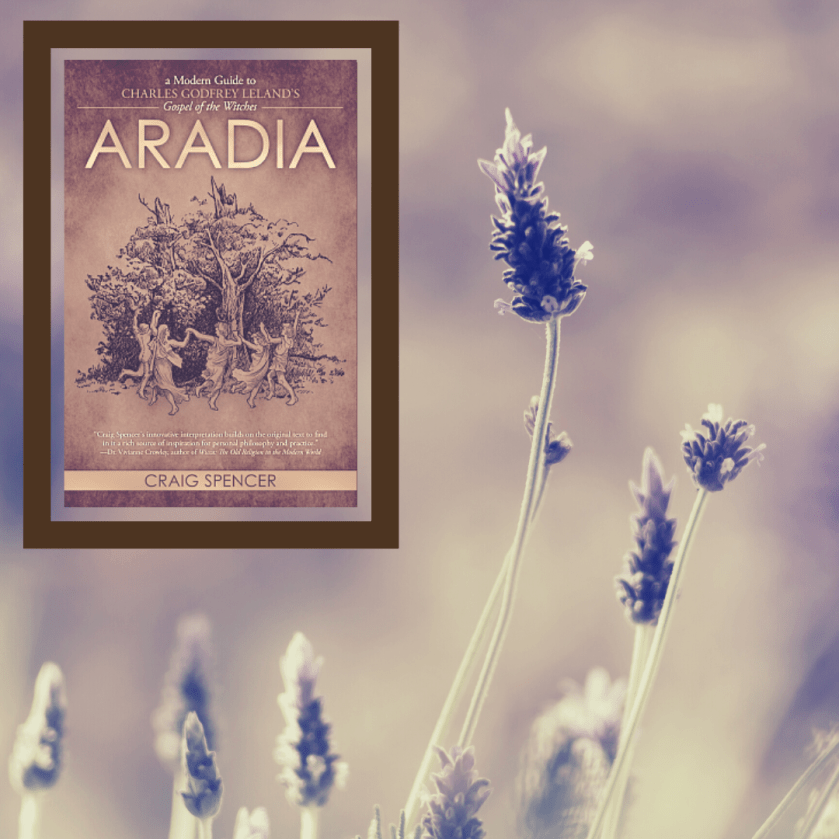
[Witchy Review] “Aradia” by Craig Spencer
Full Title: Aradia: A Modern Guide to Charles Godfrey Leland’s Gospel of the Witches
Author: Craig Spencer
Published: August 2020 by Llewellyn Publications
Genres: Nonfiction, Magic Studies, Witchcraft Religion & Spirituality, Mythology
Edition Details: 240 pages, trade paperback
Source: ARC – Requested by Me
Rating: {4/5 stars}
First Glance
In my early witchy studies, I tried to get my hands on anything written by older sources in an effort to understand the foundation of what witchcraft had become. At that time, I was a Wiccan and read through the writings of Gerald Gardner, Dion Fortune, Doreen Valiente, and other Big Name Pagans.
I tried to read Aradia, Gospel of the Witches multiple times, but I just couldn’t wrap my head around it. From the random inclusion of Lucifer to the rambling stories, I just couldn’t see anything of value for my personal path in Leland’s work, especially as I have no ties to Italy or its traditions.
Thankfully, someone who has those ties has taken the time to retranslate and discuss Leland’s Aradia. I requested a copy of the book when I saw it was available, because I hoped this time someone had made the Gospel make some kind of sense.
Positive Bits
I’ll start off by saying that Spencer made a good decision to write this book. Period. When you realize something is needed and you have the ability to provide it, I think it’s wise to step in and create a resource for others. He did a wonderful job on citing sources and noting where he changed the original translation (as well as why). It’s always a good sign when someone explains their process to you, because you can retrace their steps and see the clear delineation between points A and B.
Pointing out the Catholicism flavoring different portions of the Gospel makes the stories easier to follow. I hadn’t considered it before, but clearly local stories and folktales are colored by the cultures they live inside of; as those cultures change, so do the details of the stories. As I’ve never been Catholic, it was helpful to see the pieces that fit into the Catholic worldview separated and explained throughout the Gospel.
Spencer made sure his Part Two section included enough basic framework to point in the direction that Aradia’s witchcraft would travel without bogging it down in details. In “Attending the Sabbat”, he broke down ritual into individual portions that each tie together to form the great working. I’m always intrigued by new breakdowns of the ritual process, as the differences are often where a ritual’s magical flavor comes in.
Less Enjoyable Bits
I disagree with the premise that witchcraft is inherently a religious act. In the Gospel, I can understand and agree with the idea that the witchcraft of Aradia is meant to be a religion. However, there are so many paths of witchcraft out there that don’t interact with any higher beings, focusing instead on the use of personal and elemental energies to perform spells and rituals. I feel it’s often easy to slip on blinders as a religious witch and fail to recognize this. (As a hard polytheist and animist, I get it.)
Other than that disagreement, I actually found no issue with this book. Spencer set out to provide a better translation and context for Leland’s Aradia, and he did so. Period. I didn’t find his revelations (i.e. interpretations) to be overly invested in a personal agenda or attitude. Instead, he took the time to explain any interpretations he had that didn’t line up with Leland’s original, and he included enough sources to make checking his work possible for those so inclined.
Tidbits Worth Repeating
The moral of this story (and it could also be said of Italian witches) is that we should never attack what we do not understand. We should never attack a divinity just because our own personal path does not lead in their particular direction. Looking at the world today, this is a lesson that many people could benefit from learning – witches included. (56%)
The spirit of witchcraft is the driving force and power behind the words, not the rigid dogma of a set formula. (92%)
Be the witch you are meant to be, and let the magic of the Old Religion guide you, guard you, keep you, and show you its deep secrets. (98%)
Is it worth the coin?
Yes – I’d recommend this book for anyone interested in historical (traditional) witchcraft, particularly of Italy. It’s a good resource for anyone focused on the “Old Religion” style of witchcraft as a religious path, particularly if you’re drawn to the European and/or Wiccan paths due to their ties to a historical context.
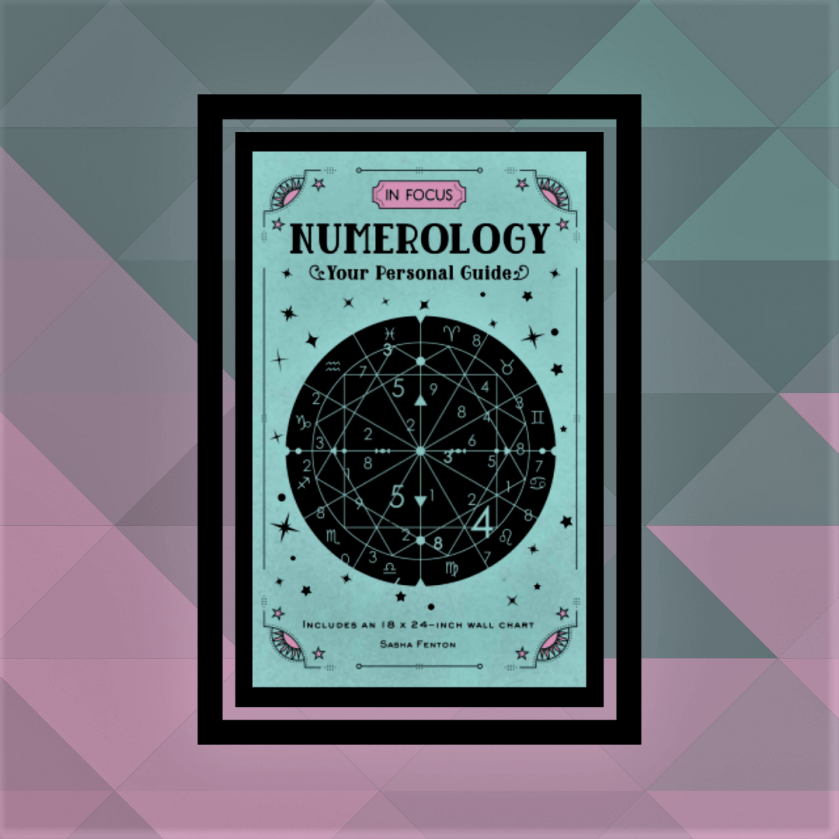
[Witchy Review] “In Focus Numerology” by Sasha Fenton
Full Title: In Focus Numerology: Your Personal Guide
Author: Sasha Fenton
Published: August 2020 by Wellfleet
Genres: Nonfiction, Numerology, Fortune Telling, New Age,
Edition Details: 144 pages, hardcover
Source: ARC – Requested by me
Rating: {4.5/5 stars}
First Glance
I hadn’t heard about this book in particular until I ran across it on NetGalley as an ARC. In my personal experience with books on numerology, I’ve been disappointed by a lack of depth. However, I decided to take a chance and try another volume on the subject.
Positive Bits
Aesthetically, this book is appealing. While not necessarily important to the topic itself, I think it’s always a sign of focus when a book is designed to be pleasing to the eye as well as informative. Think of it as an artistic investment in seeing the book reach more readers.
The author managed to cover far more numerology applications than most books I’ve run across previously. The usual suspects based on your name and date of birth are present, but then she dove into using numerology to check on specific times and dates, as well as your karmic focus for this life and your hidden passion. It even had a section on higher numbers, something I appreciated as some food for thought (particularly in a system that usually condenses all numbers down to single digits). The tidbits of historical references were well integrated, giving my researcher’s brain a place to look if I’m curious about where the basis of each practice evolved.
Another small but important feature is the inclusion of the alphabet-to-number table at the beginning of each chapter. I don’t know how many books require you to write it somewhere, memorize it, or keep a finger on the page that has that information while you move forward to learn about using it. Not having to flip back repeatedly is convenient.
Less Enjoyable Bits
This is more my personal preference than anything else, but I wish there’d been more detail on the history of numerology and the references to historical sources were explained with more depth. I like knowing the where, when, and why behind practices I use today (particularly in an effort to respect source cultures and avoid appropriation). Some of the referenced materials are familiar, like the Hermetica, so I knew more about the topic than the author shared, but overall it felt like crumbs when I wanted a full loaf of bread.
I didn’t do a word count, but it felt like some numbers received less detail in various sections. It wasn’t enough to render their information unhelpful, but it was just noticeable enough to make me wrinkle my nose. However, it might’ve also been a formatting issue, as I’m looking at an ARC. Perhaps the numbers will be formatted into individual pages, in which case an extra (or missing) paragraph will be moot (or at least less obvious).
While the overall style of the book is aesthetically pleasing, I did find some of the clipart out of place. Most of it is in the minimalist line-art style, so there’s a flow to it. But here and there, we get random pencil sketches? In Chapter 9 on The Birth Day Number, for example, there’s a section called “Day Number Crystals” with a sketch of a crystal cluster and then below that a section called “Fruit, Vegetables, Herbs, and Spices” with a sketch of a couple of apples. They aren’t bad sketches, but I flipped back through the book and found zero other sketch-styled art among the minimalist images used in other chapters.
Tidbits Worth Repeating
Sorry! This book is relatively focused on defining numbers based on what aspect of your life you’re trying to divine details from. Other than sharing the numbers that applied to me personally, I don’t think there are necessarily quotes I felt the need to share. I will note that I read all of the numbers rather than just my own, and I found them to each have a balanced amount of positive and negative details included.
Is it worth the coin?
Yes – if you want a starting point in the topic that’s not just the bare minimums, I think this book is a good resource.
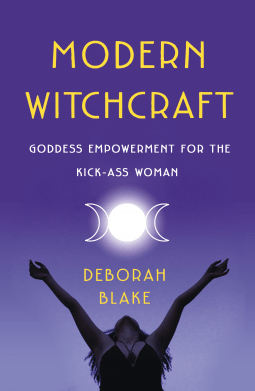
[Witchy Review] “Modern Witchcraft” by Deborah Blake
Full Title: Modern Witchcraft: Goddess Empowerment for the Kick-Ass Woman
Author: Deborah Blake
Published: July 2020 by St. Martin’s Essentials
Genres: Nonfiction, Wicca, Witchcraft Religion & Spirituality
Edition Details: 256 pages, trade paperback
Source: ARC [requested by me]
Rating: {3/5 stars}
First Glance
I was curious about this book, as I haven’t picked up many beginner-focused books lately. I figured it would be a good peek into that side of available witchy literature, and luckily it was available on NetGalley as a reviewable ARC to request. I’m not receiving anything for this review, other than having a digital copy of the book in my possession.
Positive Bits
This book is for those interested in goddess worship and Wicca. I’ll get into that shortly. However, from that perspective, the information it contains is just enough to wet your whistle. The topics all have a minimal amount of details provided, but I believe this works to give an overview of each topic rather than a deep dive that would come with later research.
My favorite section had to be Five-Minute Rituals to Connect with the Feminine Divine. Contrary to the title, the suggestions lean toward small acts of spirituality you can add to your mundane moments in life. I personally love these kinds of lists, because I’m a firm believer that you’re a witch in and out of the circle. Using an evening shower as an opportunity to cleanse both physically and energetically just makes sense, as does the simple act of thanks in the morning. When you first approach Wicca and/or witchcraft, it can feel like everything is loud and big and bright and overwhelming. The Five-Minute Rituals are ideal small steps to bring spirituality into your life without getting bogged down in checking every single box.
The same applies to a section on Practical Suggestions for Creating Positive Change. Blake describes the ways we can use our own focus to build our experience of the world. If you think negatively all of the time, you reinforce the negativity around you. By working to change your inner thoughts to something positive (like affirmations and noticing the positive around you first), you can gain a more positive outlook. This, in turn, pulls more positivity into your life – like attracts like. My favorite affirmation reminded me of the witchy animism I currently practice: “I come from the earth and the stars. I am filled with elemental power.”
Less Enjoyable Bits
This book is for those interested in goddess worship and Wicca. It isn’t for secular witches or polytheists, as it has a hard focus both on the spirituality behind worship and the idea that all goddesses are faces of the same Goddess. Considering the modern witchcraft movement and overwhelming amount of information online, this book is written in a way that would help someone interested in Wiccan-flavored goddess worship and witchcraft as a focus. I don’t think it’s good for a broader audience than that.
That said, I started off my witchcraft journey as a Wiccan and trained in a Wiccan-derived coven, so the content provided fit into my past experience. Actually, this book comes across like those from the early 2000s when I started my studies; the attitudes and beliefs match with the Wiccan witchcraft of that time period.
The resources in this book are dated. Based on my own experience, I’m going to guess that Blake stopped buying/reading introductory books after a certain point as they were no longer necessary. However, that means she references WitchVox (a defunct website that used to be helpful for finding fellow witches nearby) and no books other than her own that were published in this decade (the newest is from 2008). This isn’t necessarily a terrible thing, as Wicca itself has a core of beliefs that haven’t changed since its introduction to the public, but Witchcraft has evolved and changed in so many ways that these aged resources don’t represent the variety and depth of information now available in print.
Tidbits Worth Repeating
When Witches talk about the power of words, it is another facet of the idea that what you put out into the universe is what you get back.
The goddess loves you. Even when other people let you down, the goddess accepts you just the way you are. She doesn’t care that you aren’t perfect. She doesn’t care what color or size or age you are, whether you are gay or straight or bi or asexual. No matter what gender you were born to, if you consider yourself a woman, so does She.
And when I feel powerless or frustrated or angry, I can listen to the rain and the wind and remember that in the smallest element, there can be found the potential for incredible power. After all, a drop of rain seems innocuous until it becomes a flood, and a gentle breeze can change into a tornado that wipes out everything in its path. We may seem as tiny as a single drop of rain, but together, we can move mountains.
Is it worth the coin?
No – There are plenty of well-written books on Wicca, including many focused on specific traditions within Wicca itself. This book is just too broad in its focus to be useful, especially with the lack of current resources for a new witch to look into after reading.
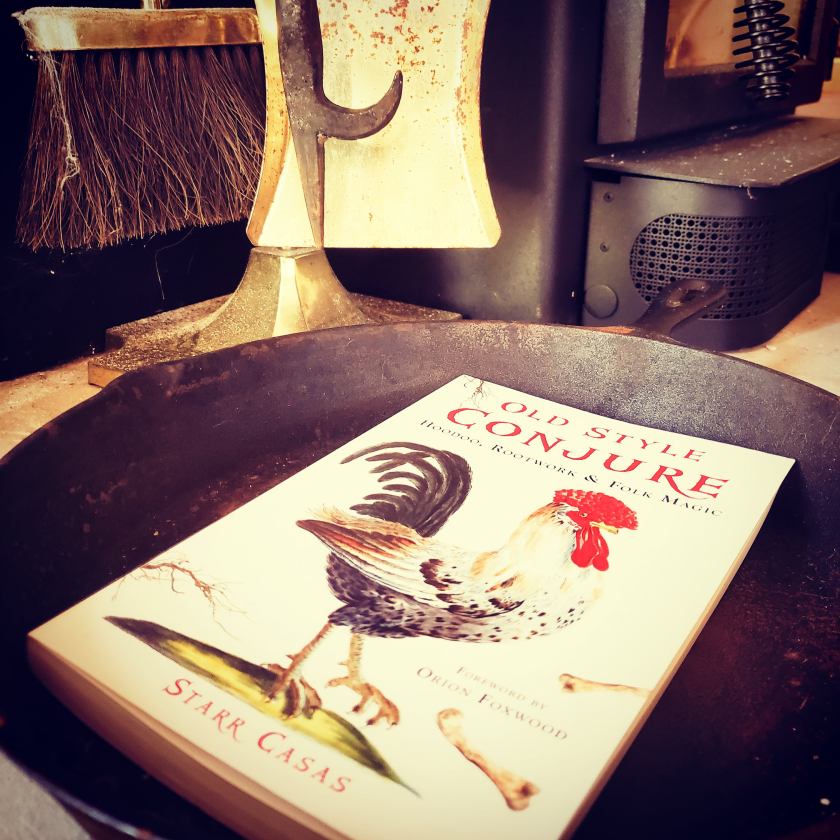
[Witchy Review] “Old Style Conjure” by Starr Casas
Full Title: Old Style Conjure: Hoodoo, Rootwork & Folk Magic
Author: Starr Casas
Published: September 2017 by Weiser Books
Genres: Nonfiction, Magic Studies, Tribal & Ethnic Religious Practices, Occultism, Spirituality, Folklore, Witchcraft
Edition Details: 256 pages, trade paperback
Source: Purchased
Rating: {3/5 stars}
First Glance
As a witch, I’ve researched and explored many different kinds of magic. Somehow I’ve managed not to end up looking into Conjure at all, by no purposeful attempt to avoid it. That said, we visited a local witchy store on my birthday earlier this year, and apparently it was time for me to learn. There was a large display of Conjure books and implements that kept drawing me back, and I knew I had to look into it. I spoke with a gentleman there who works Conjure as part of his personal practices, and he suggested a couple of books to get started. This was one of them.
Positive Bits
One of the allures of Conjure is how practical and natural its works are. Having spent over a decade in the South, I can attest to some of the practices Casas describes as “just what you do”. There are plenty of practices you do because you’re supposed to, without having any real explanation as to why. Folk magic is often passed along in this subtle way, and through “old wives’ tales” or other stories used as instruction.
The works involved in Conjure are largely built to be easily done around others without being noticed. This comes from the roots of Conjure (and its related practices of rootwork and hoodoo), where slaves had to work around those oppressing them without getting caught. With that history in mind, Casas makes an important point about power: “Folks need to remember that anything that has blood shed on it is powerful.” Being simple or easy doesn’t make Conjure any less powerful than bells-and-whistles rituals in witchcraft.
I appreciated the description of crafting your petitions, as it reflects a similar attitude found in other paths I’ve studied (and my own practices). In general, the idea is that simplicity is key, but so is specificity. You get what you ask for, how you ask for it. If you’re not specific about the how, you can’t complain about the methods used to fulfill your requests.
Less Enjoyable Bits
This is not a book I would’ve recommended to anyone new to witchcraft in general or Conjure in particular. With my background knowledge, the various works Casas shares with you make some sense; after all, if you know the magical associations often given to certain herbs, you can make some educated guesses as to the reasons for each item involved in a work. But for the most part, you’re left to follow directions blindly, a thought that makes me cringe and opposes all of the lessons I’ve experienced in using magic.
I didn’t grow up going to church. My dad’s an atheist, and my mom’s an agnostic. I have no innate familiarity (or comfort) with Christianity as a religion, and my main experiences with Christianity haven’t been positive (witch + LGBTQ + woman = trouble in the South). Perhaps others may speak differently, but Casas made it abundantly clear that the constant Christianity within Conjure is required. While changes can be made to works in order to fit modern issues and legalities, changes to the use of biblical verses are sacrilege.
While I respect the reason why Christianity was used in Conjure’s origination (i.e. slavery and adaptation), I don’t understand the insistence that the folk magic aspects cannot be used without the Bible and still be Conjure, yet Conjure isn’t a religion and doesn’t require you to be a Christian. Why couldn’t someone worship the ancestors in a non-Christian format and use Conjure works without the Bible? Wouldn’t that still honor the history of the works? Why is it okay not to follow through on one part of a work (throwing a war water jar at someone’s door) but not another (praying to God for your petition instead of, say, Zeus)? I will always struggle with anything that fails to explain the why.
Tidbits Worth Repeating
What is an altar? The altar is nothing more than a home for Spirit to sit. It’s the place between places where this world meets the spirit world. – page 35
An offering can be as simple or as elaborate as you want it to be. An offering can be a stone you found somewhere and felt drawn to bring home, or maybe a bird’s nest that had fallen out of a tree, or just a simple glass of cool water. – page 41
Words are power, and Spirit listens to our prayers and petitions. – page 181
Is it worth the coin?
No – unless you’re a Christian, in which case this book might be a bridge toward using magic in a context that is comfortable and compatible with your personal path. Without that base knowledge and worship, I’m not sure how to connect to the magics offered in this book.
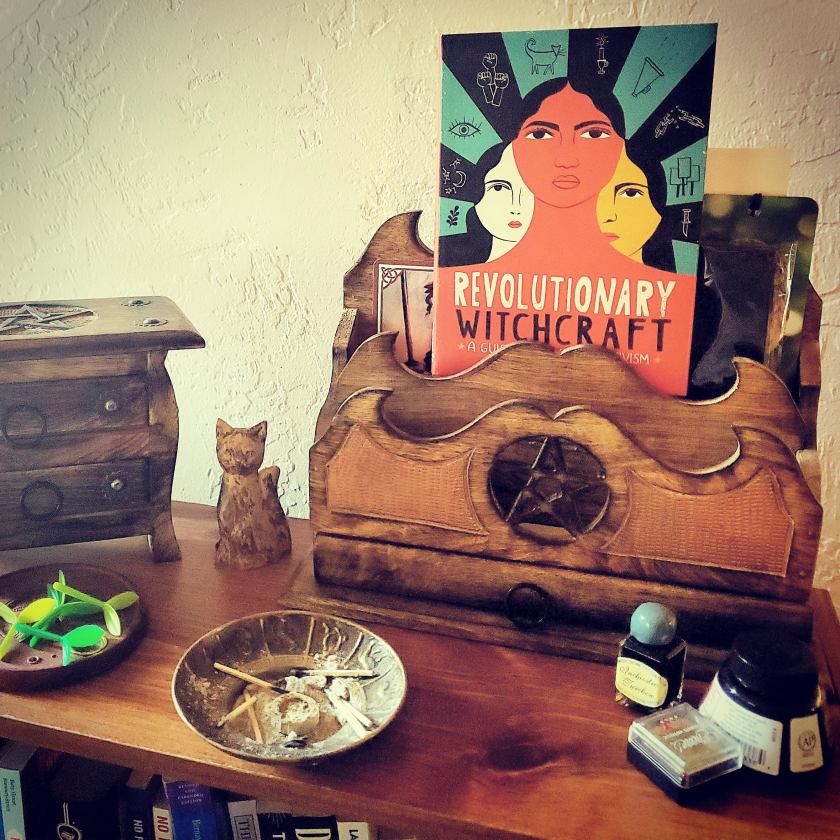
[Witchy Review] “Revolutionary Witchcraft” by Sarah Lyons
Full Title: Revolutionary Witchcraft: A Guide to Magical Activism
Author: Sarah Lyons
Published: November 2019 by Running Press Adult
Genres: Nonfiction, Women in Politics, Democracy, Occultism, Witchcraft, Social Justice
Edition Details: 168 pages, flexibound
Source: Purchased
Rating: {3/5 stars}
First Glance
With the Black Lives Matter protests against police brutality raging (rightfully) across the country, this book is part of half a dozen resources I decided to purchase. I’m working from home and fully self-quarantined for safety, but I wanted to make some kind of difference. Part of that has been a decision to put my magic where my mouth is, so to speak.
Positive Bits
The premise of this book is set from the start, that activism is a form of magical action. If magic is about directing power (energy) toward a goal, so is politics. There aren’t necessarily as different as you might think. That said, this book is clearly for direct and physical activism, rather than magical works. If you’re looking for a way to merge action with magic, then you’ll find it.
I appreciated the section on getting in touch with your ancestors, as the author took time to point out that ancestors of spirit (i.e. non-familial beloved dead) are valid. As someone from a small and scattered family, I don’t have the ability to trace back my bloodlines very far. However, there are elders that came before me who directly shaped me as a witch (like Scott Cunningham). With found family being such a bit part of both the witchcraft and LGBTQ+ communities, it’s nice to be reminded that it’s not always about blood.
The book also describes the reality of Trump as America’s Shadow. He’s the culmination of our darkest urges and realities, not an outlier. In discussing this, the author points out how unsurprised some oppressed groups were when Trump got elected; after all, when you spend so much time being mistreated by your country, the idea that there are enough people who think like Trump to elect him isn’t that far-fetched. I can definitely relate, as someone who lived as an LGBTQ+ witch in Texas for a decade… it’s exhausting to face the societal Shadow day in and day out, but some people don’t have the luxury of ignoring it.
In the ritual portion of the book (the appendix), the author explains how you can take premade spells and make them your own by localizing your magic. For example, you can look at the native plants in your area and figure out their magical associations. Once you have a list of local magical herbs, you can use them in place of hard-to-obtain or unfamiliar herbs in spells. Being tied to your area makes your magic more effective, because you’re literally harnessing your homeland (i.e. the land around your home) for assistance.
Less Enjoyable Bits
This book is not about witchcraft for the revolution. As mentioned in the Positive Bits, there’s an appendix of rituals and spells; however, there are only a handful offered and nothing particularly useful for those of us trying to help the activists from home. To be fair, the book was written in the pre-quarantine life we once had, but it was a disappointment to have the focus largely be on direct, in-person activist works.
Occasionally, the tone of the author is dismissive in places I found unpleasant. They brushed off the use of beauty products in a dismissive tone, ignoring the cultural aspects of cosmetics that have existed in mundane and magical life for centuries. They also brushed off deity worship in general. As someone who practices both animism and hard polytheism, I find it a bit disrespectful to dismiss gods and goddesses as a whole due to the vague belief that some worship Mother Earth as “a white woman with long hair and conveniently placed leaves”. The attitude is sporadic in a few topics rather than existing throughout the book, so it’s not a deal breaker if you’re interested in the rest of the book. Just be aware that some areas might make you irritated.
One magical issue that I found questionable was the entire section on “Magic in Action: Shape-shifting and Soul Flight”. Call my old school, but I don’t think one of the few magical practices you introduce in a beginner’s witchcraft book should be leaving your body. Period. It’s mentioned without first considering the processes of grounding and centering, and it comes before even basic meditation instructions are given(!?). While I don’t have a deep need to hold off on astral travel, soul flight, shape-shifting, and similar topics until you’re initiated a dozen levels into a coven, I *do* feel like there needs to be quite a bit more work toward basic self-awareness before leaving yourself behind.
Tidbits Worth Repeating
Just like in magic, politics is about feeling the flow of power, finding it in yourself, and combining it with other people’s to make something happen. – page 7
Initiation is any ritual or event that sort of breaks open your brain and makes you realize the world is a lot weirder and bigger than you previously thought. – page 39
Reality is malleable, like the code in a computer. It’s both highly structured and highly able to be fucked with. – page 96
Is it worth the coin?
No – this book isn’t about witchcraft so much as it’s about finding a spiritual tie-in between activism and witchcraft. The pieces I enjoyed are all available with more depth in other books, and the rest is just a really big protester pep talk with witchy sprinkles.
werewolf troubles [poem]
they don’t like it when you growl
teeth glinting in the moonlight
they don’t like to be reminded of their place
because humans think themselves predator rather than prey
they don’t like being made to tremble
at the sound of a distant howl
they don’t like cowering in their homes after sunset
you don’t care what they like though
because they seem to like you just fine
when you walk in human skin
as if you’re safe to be around
just because the moon isn’t quite full
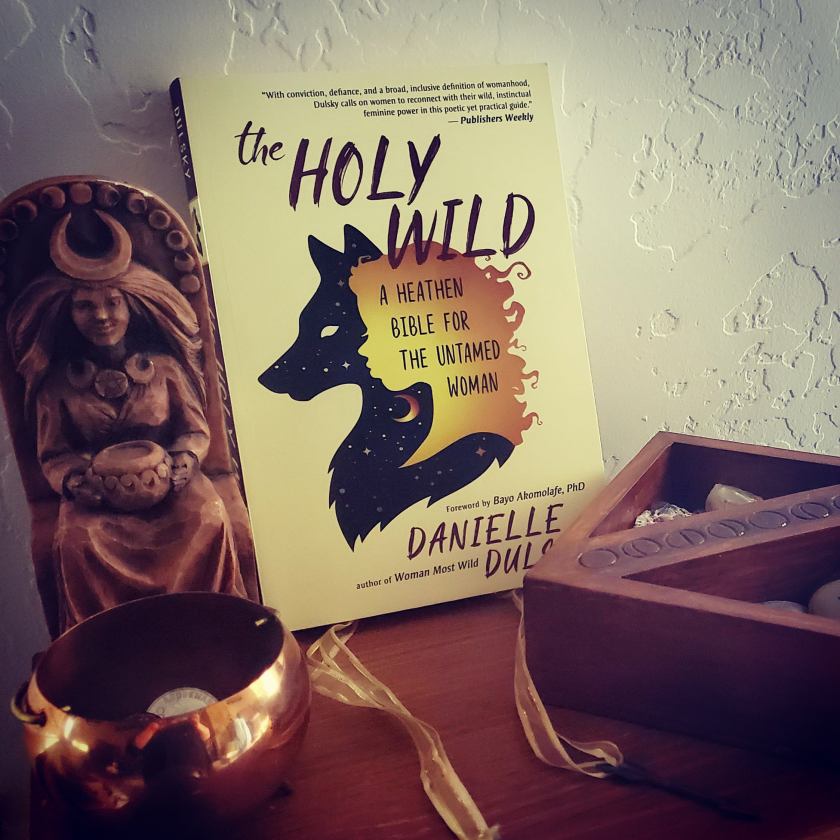
[Witchy Review] “The Holy Wild” by Danielle Dulsky
Full Title: The Holy Wild: A Heathen Bible for The Untamed Woman
Author: Danielle Dulsky
Published: September 2018 by New World Library
Genres: Nonfiction, Wicca, Gaia-based Religions, Comparative Religion, Spirituality
Edition Details: 304 pages, trade paperback
Source: Purchased
Rating: 3.5/5 stars
First Glance
To be candid, I bought this book based on the cover. My mate and I have matching hoodies with that wolf-woman image on it, and I couldn’t resist taking a closer look at a book with the same art on the cover. Since it was in the New Age section, I took a chance and grabbed it without looking up reviews or skimming the contents.
Positive Bits
Right off the bat, let me applaud Dulsky for how easily equality slipped into the story. Even though the title would imply this book is focused on cisgender folks, she immediately makes it clear (less than a dozen pages in) that she chose to emphasize the pronoun She/Her while seeing that divinity as “irrefutably pan-gender”. Again and again, she makes it clear that all feminine-leaning folk are welcome, regardless of physical form, to include mentioning their ability to use a Prayer for the Energetic Womb without having a physical womb (as it is about the energies of creation). This isn’t a common practice in books, which are either actively cisgender in their focus or passively so.
The writing portions throughout the book encourage you to write your own mythology, and to recognize the God-Goddess-Mystery within yourself in each story. As a writer myself, I find guided journaling to be an important tool for spiritual growth. The appendix at the end includes further questions and meditations to ponder, all of which fit in nicely with the path she outlines throughout the book.
I think there’s a lot of beauty in the poetic-prose Dulsky used to tell her tale. She built the book to be used out of order, and it shows in the way she allowed each elemental section to stand alone in its own story.
Less Enjoyable Bits
As someone who has never been a Christian, I have a hard time connecting to biblical stories. Unfortunately, the main myth that’s retold in each section is based on a feminine figure from the Bible. Salome, Mary Magdalene, Lilith – they all have interesting pasts and are retold with a beautiful shift to the focus of each story, but I’m not familiar enough with the Christian mythos to really connect with them on the level Dulsky likely hoped I would.
Another issue came in the form of an unexplained reference to “the Red Road”. After getting about 50 pages in, I finally looked onto for what she might be talking about. I assumed it was Christian, but it actually comes from a loose interpretation of various Native American beliefs. Considering how often it came up, I’m surprised to say she never explained it from start to end.
I don’t think this book is made to be read in one sitting. I read it all at once, and the poetic-prose became a little foggy after too much flowery imagery. If you read it in pieces over a few days, though, I think that’d be mellowed out to something more enjoyable.
Tidbits Worth Repeating
I am sucking the poison of patriarchy and privilege out of the soil and spitting it moonward, for these are the dire days of the fallen kings and raising queens. – page 44
There are few things in this world that cause more anguish than realizing that you are not who you thought you were, and, quite often, such a realization comes on the heels of a great wounding. The sword of the Dark Goddess hits us in the belly, the seat of our sense of self, and forces us to release the parts of our outward identities, the masks we show the world, that have become restrictive to our souls, the truest parts of ourselves. – page 130
The skeleton of any spell is formed from intention and energy raising, with its specific shape, the flesh laid over the bones, sculpted from the infusion of energy into the intention. – page 193
Is it worth the coin?
Yes(ish) – if you’re looking for a guide on exploring your ties to divinity and your personal mythos, I think this is a great starting point. If you’re looking to explore goddess worship, I’d find a simpler and more focused resource.
siren’s song [poem]
do you hear the insistent rhythm of my heartbeat drum
or the melody of my breath?
do you feel it crawling under your skin
like the ink of a new tattoo
a permanent mark in the making?
do you worry
wonder if this siren song is just a trap plainly seen
or a clever ruse to distract you?
do you see it?
everything you need is reflected
on the surface of the waters
waiting
for you to reach in and
succumb to the lure of the ocean
 Larissa Lee