Posted in [fiction reviews]

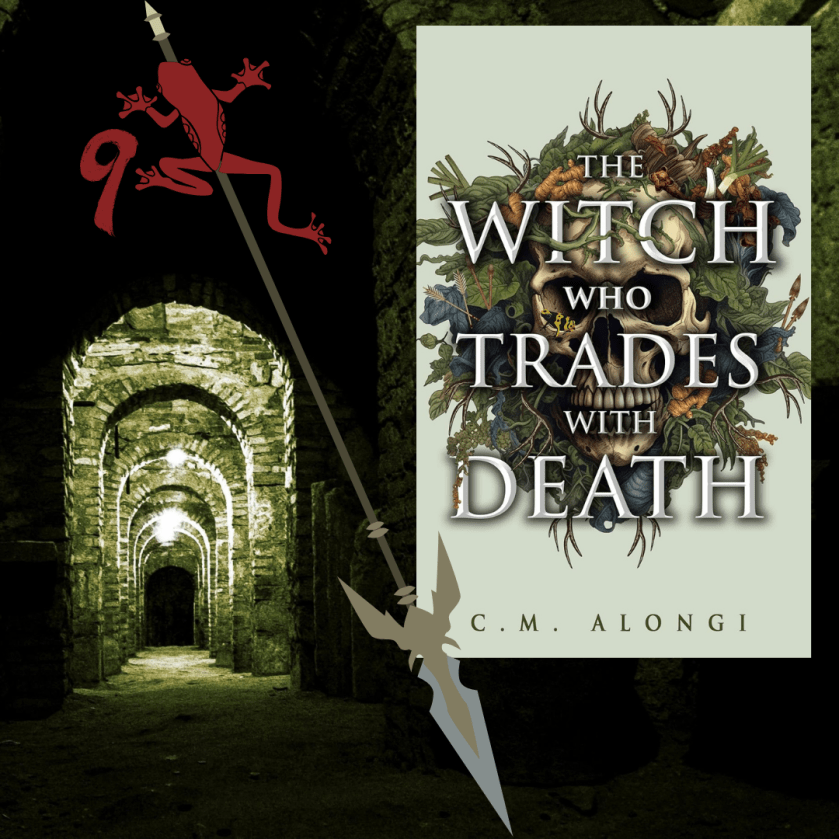
[Fiction Review] “The Witch Who Trades with Death” by C M Alongi

Full Title: The Witch Who Trades with Death
Author: C M Alongi
Published: March 11, 2025 by Angry Robot
Genres: Fiction, Fantasy, Epic Fantasy, Action & Adventure, LGBTQ+
Edition Details: 384 pages, hardcover (my copy was 488 pages, paperback)
Source: ARC – Requested directly
Rating: {5/5 stars}

First Glance

I followed this author on TikTok ages ago for her CaFae Latte skits, long before I realized she had published anything. When this book was described, I found myself intrigued by this potential twist on a story where Death is a character. I even wondered if it’d be written along the lines of a Persephone retelling, where the witch would fall in love with Death himself… but regardless, the description of a witch having to make deals with Death to survive had me jump at the opportunity to apply for an ARC.

Themes listed: trauma and overcoming it; fear vs courage; refugees; racism & xenophobia; toxic vs healthy relationship; found family & the power of friendship.

Content Warnings listed: graphic violence; sexual abuse; death; self-harm.

Positive Bits

Right off the bat, I’m in awe of how well Alongi handled all of the heavy topics listed for this story. As a survivor of sexual abuse, I was prepared to be made uncomfortable as we followed the story of an unwilling concubine. It implies certain experiences have to occur. While we do bear witness to abuse at the hands of the Emperor, it’s written with such nuance that we don’t have to experience it directly to recognize and hold its weight. The level of writing craft that went into this story will have me re-reading it for tips on how to do the same in my own work.

One of my favorite characters in this story is an old whore from a brothel with a no nonsense attitude and a twinkle in her eye. Sex work is treated as a completely valid and even borderline respected industry in the culture of our witch Khana’s new refuge. Similarly, all forms of representation are handled as vitally normal within the story. We see sign language used by someone with an injured throat, an amputee with a prosthetic leg, and a wide range of ability or disability among warriors in their village. We see a variety of relationships, including a hilarious request by a woman’s mother that she provide grandchildren with her AFAB nonbinary partner by either finding a third or adopting (she’s not picky). All in all, it was the way all of these diverse and unique characters were woven in as natural to the world they exist in that made the representation feel authentic instead of tokenized.

I appreciate closure in a story, especially if there’s a clear Bad Guy and Good Guy in the situation. Without getting too into the weeds or providing spoilers, I can say that the end of the story left me satisfied. There weren’t any frustrating loose ends or unanswered questions, and Khana got to grow into herself as both a witch and a person. The emphasis on found family and community made me teary eyed in the best possible way! All in all, this book full of heavy topics is surprisingly uplifting (at least to me) and left me in a good mood once I finished it.

Less Enjoyable Bits

I want more, but that’s the epic fantasy reader in me. Even if we’ve reached the end of the current problem, there are still bad people doing bad things out there. I would be very happy to hear Alongi say she’s planning another book in this world, even if it has nothing to do with Khana’s story.

There’s a fine line for those with trauma when it comes to reading about someone else’s. While I thought the balance in this story was perfect and didn’t trigger me, I could see it being a difficult read for someone with fresher wounds (especially anyone who has experienced domestic violence or sexual abuse). Go into this story expecting it to be hard in some places, but know that healing is part of their experiences as well. I trusted Alongi’s writing to handle the topics as well as her skits do on TikTok, and that trust was well placed. I just urge caution.

Is it weird to say I wanted more Death? While Death plays a vital role as a character and even gains a personality as we watch interactions between Death and Khanna, I found myself wanting to see more of those moments. We’re given enough to understand Death as a being with specific rules and attitudes, but that’s it. None of Death’s decisions or actions surprised me, but I still felt like I was missing something from them. Then again, I have a deep love for Death as a major character in stories, so this might just be a me thing.

Tidbits Worth Repeating

She didn’t truly believe in gods. And if they were real, they have ignored her prayers and those of all the other concubines. If they existed: she hated them. And yet, desperate times…

How did we get from me teasing you about your obvious crush to you both making me feel feelings? I’m outnumbered. This is unfair.

There was a place for her here. People who cared about her and who she cared about in turn. A future of joy and contentment and maybe some tragedy, but also healing and love. She was home.

Is it worth the coin?

Yes – I had planned to buy this book before asking for the ARC, so I already thought so. Now? Heck yeah, it’s an amazing piece of writing craft and a great story to boot!
Posted in [fiction reviews]

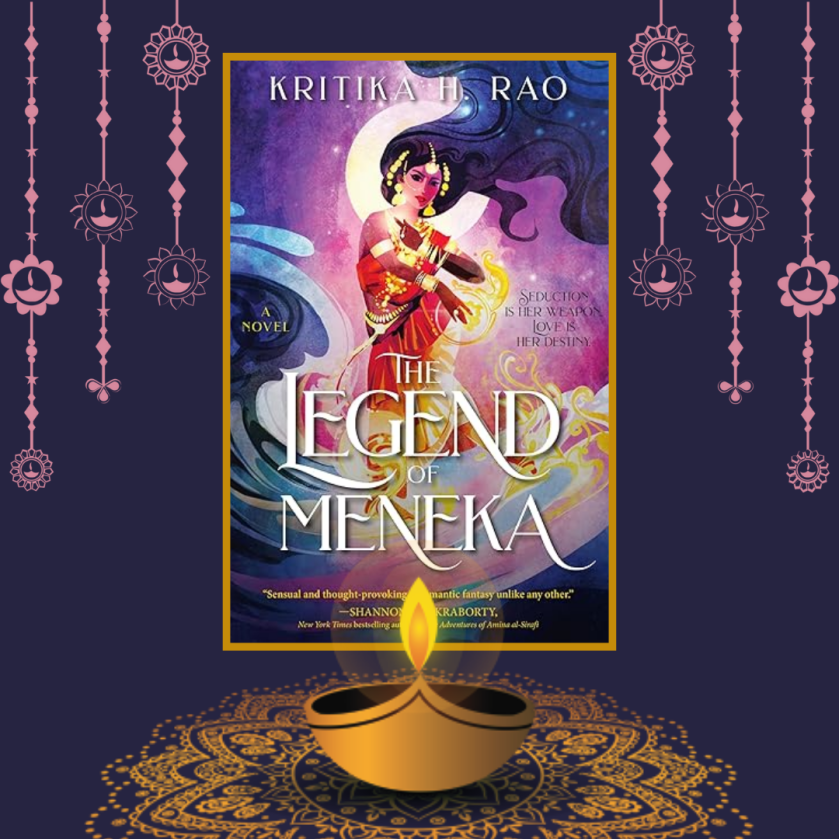
[Fiction Review] “The Legend of Meneka” by Kritika H. Rao

Full Title: The Legend of Meneka: A Novel (The Divine Dancers Duology 1)
Author: Kritika H. Rao
Published: January 21, 2025 by Harper Voyager
Genres: Fiction, Fantasy, Romance, Romantasy, Adult Fiction, Mythology Retelling, Hindu Mythology
Edition Details: 368 pages, hardcover (my copy was paperback, 357 pages)
Source: ARC – requested and won via Goodreads
Rating: {5/5 stars}

This is a spoiler-free review. No details will be shared from the storyline itself that aren’t available or inferred from the book jacket and online descriptions.

First Glance

I’m a deep lover of mythology retellings, but I’ve made it a personal challenge to find non-Greek stories to read. I’ve yet to be disappointed by a retelling, even for myths I had no background understanding of before reading.

That said, I happen to love unique magic and requested this book when I read that apsaras used dance as the focus of their magical workings. Add in the enemies-to-lovers listed on the book’s listings, and I had to enter to win an ARC.

Positive Bits

Right off the bat, I want to note that I appreciated the use of spice fit perfectly into the story and the main relationship’s growth at the time. As apsaras are described on the book blurb as warriors of seduction, I honestly expected there to be gratuitous scenes to demonstrate that purpose. The author instead used spice as a delicious seasoning to enhance the story where it best applied, while making it make sense in the context of the myth being told.

The author managed to deftly use the enemies-to-lovers trope without falling into its less entertaining traps. I find myself struggling with the trope most often when miscommunication is the sole basis of the “enemy” side of the equation. I personally find that miscommunication in romances turns me off, kicking me out of immersion in the story as I consider all the simple solutions to the problem at hand. This story is woven to make the shift from enemies-to-lovers feel natural and expected in all of the best ways.

As I read the author’s notes at the end, I appreciated that she chose to take Meneka’s myth and expand upon her character. The idea was to make her real and whole in a way the original myths don’t allow, and I think this book truly honors that goal by following Meneka’s story of self-discovery as the primary thread holding the romance and fantasy portions of the book together.

Less Enjoyable Bits

The ending disappointed me, but in an expected way. There’s a hard cliffhanger, because we hit the crescendo of the action and then stop – with book 2 presumably picking up from there in the future. I knew there was a high chance of a cliffhanger, but I was still bummed at where it stopped. (And yet, it just makes me eager for book 2, so maybe it had the intended effect?)

I appreciated the glossary at the start of the book, but I would’ve liked to see other items and words included on the list. It mostly includes mythological people and objects, but there were pieces of clothing and other cultural references I had to look up on my own. Since I was reading a physical book, I didn’t have my phone readily at hand to clarify what we were looking at.

Given the notes of “an empowered, seductive FMC” and “spice & yearning”, I found the amount of seduction and spice actually found in the story to not match my expectations. I didn’t mind the discrepancy per se, but I feel like it’s important to point out for anyone who might be interested in the spicy side of the story more than the mythology. I still enjoyed the story and Meneka’s character arc, with or without more heat.

Tidbits Worth Repeating

My heart skitters in my throat. I totter on the precipice of something terrible, something beautiful.

We are two opposites bound to each other in this game of mark and seducer, each of us taking either role, unknowing, unaware. The lust I saw in him is mine, the empowerment of everything I can be, realized through the mirror he holds up to me.

We dance, and create, and hope.

Is it worth the coin?

Yes – If you like retellings of mythology, this is a wonderful story! Also, it’s great even if you aren’t familiar with Hindu mythology. I had very little base knowledge, and I still followed along and enjoyed the story on its own. I look forward to the second book and plan to get it once it’s written/available.

Posted in [book reviews], [witchy reviews]

Magic is about manipulation?

“Magic, at its core, is about manipulation and directly attempting to make something happen. Whether it’s to heal or hurt, bind or repel, create or destroy, magic is a process by which the manipulation of either the spiritual or mundane world occurs.” – page 60 “Hellenismos Today” by Timothy Jay Alexander.

He goes on to say that Pagans show great hubris in believing they control or hold power over anything, and that everything happens as part of the Gods’ will.

I have to start off saying that I enjoyed (and devoured) his book, and I’ve started reading “Beginner’s Guide to Hellenismos” as well. But that said, I have to point out a few flaws in Mr. Alexander’s arguments (and writing…)

First, I can’t stand when someone repeats the same argument point over and over. On several occasions (as in mentioning the hubris of Pagans), he makes a point only to repeat it word-for-word on the next page. Having someone help edit his work may have avoided that issue. He also makes an unfortunate habit of claiming no disdain for a group (Pagans, Christians, etc.) only to turn around and bash said group for the next two pages. He comes off as the type of person who, in a face-to-face conversation, would make me walk away to avoid bumping into the brick wall of his “authority” over and over… and over… and over…

But the quote above had me thinking… how would I defend myself from such a claim? Can I? I spent my lunch break (and laundry time after work) examining my personal beliefs and practices, and I have a rebuttal.

As a Pagan, I do practice magic, though rarely. I find that prayers come first, because often I’m not in need of something specific (“I need money to get that operation.”) so much as something for my general well-being (“Please help me make tomorrow a better day.”) But I do practice magic, hubris-free.

Mr. Alexander says that a Hellenismos will write down a prayer, read it aloud to their deity, burn it, and then burn some incense or other offering in honor of that deity. In doing such a devotion, they please that deity and often it will in turn grant their desire (if reasonable… and yes, I know using “it” to talk about deities might feel weird… but it’s unisex!).

My personal belief is as such: When I cast a spell, I pull together my personal energies and those of elements around me and send them out with my desire. Often, my spells include a prayer to a deity; as I’ve always been most attracted to the Greek pantheon, it’s usually a Greek god or goddess. I also light incense, or a candle, as a focus and as a carrier to send my energies out to do their task.

But in my personal beliefs, we all send energies toward “the Universe” (capital U) with the understanding that It will determine what’s best for the good of all and grant us success or failure as necessary. The Universe may even let something bad we’ve cast fall back on us, as a lesson. But when the Universe is capitalized, it is like the Ultimate Divine Source. We cast our energies out to the Source with our intentions, when the Source sends back the results (success, failure, karmic ripples, etc.).

And when you or I use a specific deity’s name in our spells and prayers, we are essentially asking that particular deity to take notice. (In this, I agree with Mr. Alexander that Pagans as a whole often fail the gods in using them for a spell because they fall into a useful archetype.)

So, all in all, I guess I’m saying that my spells may be more empowered than a Hellenismos prayer, and I may be more focused than theirs. But I believe the Gods (whichever you believe in, all as One or as individuals) determine our magical “power”. They would not let us overpower Them; They are Gods. Duh. It’s not hubris to think that I’m an empowered worshiper, free to make moves with the essences around me and in me, to try and achieve what I desire. My gods will stop me or teach me a very painful lesson (or both) if I overstep. And I acknowledge that. If anything, I am empowered by my gods.

For anyone interested in modern Greek religious reconstruction, Timothy Jay Alexander’s books are a good place to leap from. His book for beginner’s is better than “Hellenismos Today”, as the first is like a rough draft version of the second (as though he published one, felt it was lacking in information, and went back for a second edition). And you’ve been warned, you prideful Pagans, that you’re full of hubris and need to be more respectful. /glare/

Posted in [witchcraft & wonder], [writer stuff]

Greek research

It’s that time of year again, when the CMA festival is on it’s way. The Council of Magickal Arts is a non-profit religious organization, and they have two huge festivals each year to celebrate the Pagan wheel of the year (Beltaine and Samhain). I’m looking forward to the visit, again, because it’s a vacation from the mundane world and its stresses. On top of that, I’ve convinced a friend to come along, so we’ll have a rockin’ awesome time.

It’s been a tough year. I was keeping a blog on Myspace, but I’ve deleted mine and gotten a Facebook instead. Work has been up and down, just as most things in life. The muses haven’t whispered to me much, but then again, I may not have been listening very well. Stress and frustration had actually caught up to me so badly this past month that I’m on hiatus from my coven studies. I found myself acting completely horrid (i.e. bitchy, not witchy) and needed to take time to fix that.

My recent research has been into Greek mythology and worship. I found this amazing book called “Mysteries of Demeter”, found here. While I’m not a reconstructionist, I find myself inspired by the book and it’s in-depth look at ancient pagan practices. Recently, I’ve been toying with the idea of writing a workbook on Greek (modern) paganism. There are workbooks for runes, tarot cards, goddesses, and self-discovery in the New Age section of our store, but you don’t find any books on Greek mythology and practice. There are books on Celtic paganism (because, let’s face it… Wicca started in Europe and was based more on the Celtic practices than anything else). The book above was in a local pagan store, Gaia’s Garden in Copperas Cove, TX. I’d like to see more books on modern pagan practices using the ancient Greek gods; if the Celtic gods are so popular, why can’t the Greeks be so too? I mean, we learn about the Greek gods in grade school, long before we hear about the Celtic gods (if at all, as far as school goes).

There’s an upside to this inspiration. To write such a book, I have to do research and experiment with some practices and minor rituals. I will have to take time to focus on them. I’ve always loved the idea, but I’ve never had any reason beyond a personal interest to look at any pantheon. Now, though, I feel like the muses are kicking me in the rear, trying to get me to write it out. And during this hiatus, I have a focus to keep myself from getting lazy. I’ve been so tired and stressed from work (our store just moved, and there’s lots of drama to go with that) that I just haven’t been able to get the energy to clean my house, let alone worship anyone for anything.

I’m going to try and blog here more than once a year… being a writer, that shouldn’t be a problem.

Next time I’ll share a few of the ideas (and possibly some test-it-out results) that I’ve gotten together for Demeter, Dionysus, and Gaia (just to name the first few I’ve brainstormed). Blessings!!

Posted in [fiction reviews]

Book Review: “Hush Hush”

Hush Hush on Amazon.com

I’ve decided to review the books I read here. I have eclectic tastes, but I lean mostly toward the supernatural and romance genres. I don’t discriminate against books because of their target audience (teen books, for example). And if you like any of the books I’ve listed as owned and read on my Shelfari.com page, you’ll know that my taste reflects in my review. So here goes.

I read Hush Hush thanks to an advanced proof sent to our Hastings. The cover caught my eye, so I decided “what the heck” and tried it out.

First of all, let me say that I don’t usually like first-person stories, but this one was great. I didn’t really realize it was first-person; the plot was awesome enough to distract me from that. The characters were well developed, along with the introduction of the supernatural factor: angels.

The book entails a fallen angel’s actions and a high school girl’s feelings. It’s not just some corny romance (though there is some romance here and there), but instead a look at how a person can change even after a lifetime or two, or three, spent committing wrongs. It’s also about a struggle between doing what’s best for yourself and what’s better for those around you.

Without ruining the plot, I can’t say much else. But it’s a worth-while read. It officially comes out sometime this year, October 13th. Go read it!!