Posted in [witchy reviews]

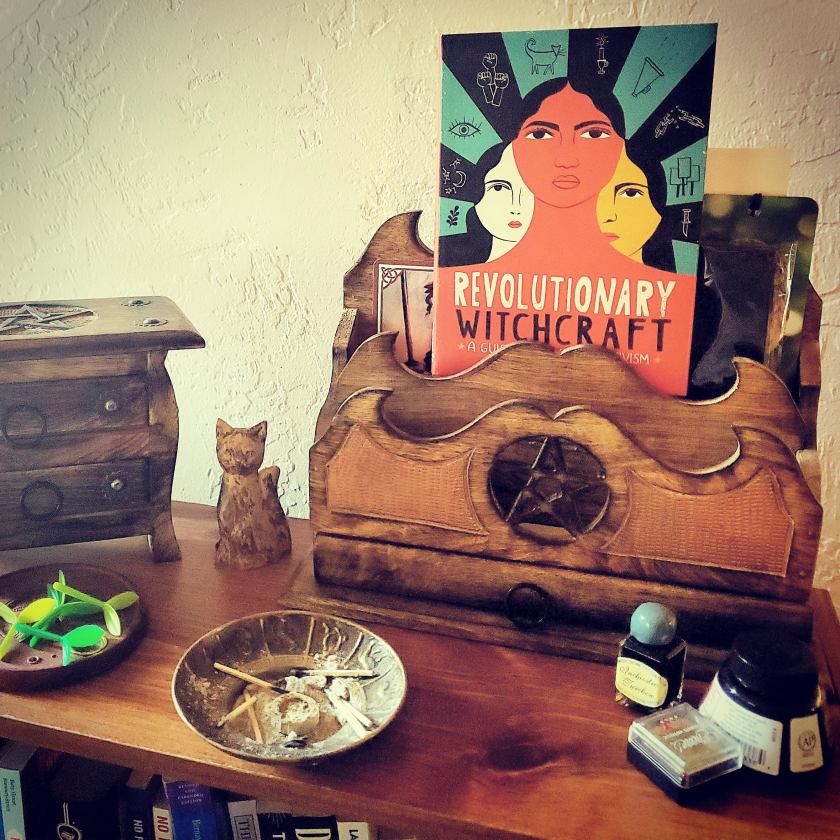
[Witchy Review] “Revolutionary Witchcraft” by Sarah Lyons

Full Title: Revolutionary Witchcraft: A Guide to Magical Activism
Author: Sarah Lyons
Published: November 2019 by Running Press Adult
Genres: Nonfiction, Women in Politics, Democracy, Occultism, Witchcraft, Social Justice
Edition Details: 168 pages, flexibound
Source: Purchased
Rating: {3/5 stars}

First Glance

With the Black Lives Matter protests against police brutality raging (rightfully) across the country, this book is part of half a dozen resources I decided to purchase. I’m working from home and fully self-quarantined for safety, but I wanted to make some kind of difference. Part of that has been a decision to put my magic where my mouth is, so to speak.

Positive Bits

The premise of this book is set from the start, that activism is a form of magical action. If magic is about directing power (energy) toward a goal, so is politics. There aren’t necessarily as different as you might think. That said, this book is clearly for direct and physical activism, rather than magical works. If you’re looking for a way to merge action with magic, then you’ll find it.

I appreciated the section on getting in touch with your ancestors, as the author took time to point out that ancestors of spirit (i.e. non-familial beloved dead) are valid. As someone from a small and scattered family, I don’t have the ability to trace back my bloodlines very far. However, there are elders that came before me who directly shaped me as a witch (like Scott Cunningham). With found family being such a bit part of both the witchcraft and LGBTQ+ communities, it’s nice to be reminded that it’s not always about blood.

The book also describes the reality of Trump as America’s Shadow. He’s the culmination of our darkest urges and realities, not an outlier. In discussing this, the author points out how unsurprised some oppressed groups were when Trump got elected; after all, when you spend so much time being mistreated by your country, the idea that there are enough people who think like Trump to elect him isn’t that far-fetched. I can definitely relate, as someone who lived as an LGBTQ+ witch in Texas for a decade… it’s exhausting to face the societal Shadow day in and day out, but some people don’t have the luxury of ignoring it.

In the ritual portion of the book (the appendix), the author explains how you can take premade spells and make them your own by localizing your magic. For example, you can look at the native plants in your area and figure out their magical associations. Once you have a list of local magical herbs, you can use them in place of hard-to-obtain or unfamiliar herbs in spells. Being tied to your area makes your magic more effective, because you’re literally harnessing your homeland (i.e. the land around your home) for assistance.

Less Enjoyable Bits

This book is not about witchcraft for the revolution. As mentioned in the Positive Bits, there’s an appendix of rituals and spells; however, there are only a handful offered and nothing particularly useful for those of us trying to help the activists from home. To be fair, the book was written in the pre-quarantine life we once had, but it was a disappointment to have the focus largely be on direct, in-person activist works.

Occasionally, the tone of the author is dismissive in places I found unpleasant. They brushed off the use of beauty products in a dismissive tone, ignoring the cultural aspects of cosmetics that have existed in mundane and magical life for centuries. They also brushed off deity worship in general. As someone who practices both animism and hard polytheism, I find it a bit disrespectful to dismiss gods and goddesses as a whole due to the vague belief that some worship Mother Earth as “a white woman with long hair and conveniently placed leaves”. The attitude is sporadic in a few topics rather than existing throughout the book, so it’s not a deal breaker if you’re interested in the rest of the book. Just be aware that some areas might make you irritated.

One magical issue that I found questionable was the entire section on “Magic in Action: Shape-shifting and Soul Flight”. Call my old school, but I don’t think one of the few magical practices you introduce in a beginner’s witchcraft book should be leaving your body. Period. It’s mentioned without first considering the processes of grounding and centering, and it comes before even basic meditation instructions are given(!?). While I don’t have a deep need to hold off on astral travel, soul flight, shape-shifting, and similar topics until you’re initiated a dozen levels into a coven, I *do* feel like there needs to be quite a bit more work toward basic self-awareness before leaving yourself behind.

Tidbits Worth Repeating

Just like in magic, politics is about feeling the flow of power, finding it in yourself, and combining it with other people’s to make something happen. – page 7

Initiation is any ritual or event that sort of breaks open your brain and makes you realize the world is a lot weirder and bigger than you previously thought. – page 39

Reality is malleable, like the code in a computer. It’s both highly structured and highly able to be fucked with. – page 96

Is it worth the coin?

No – this book isn’t about witchcraft so much as it’s about finding a spiritual tie-in between activism and witchcraft. The pieces I enjoyed are all available with more depth in other books, and the rest is just a really big protester pep talk with witchy sprinkles.
Posted in [witchy reviews]

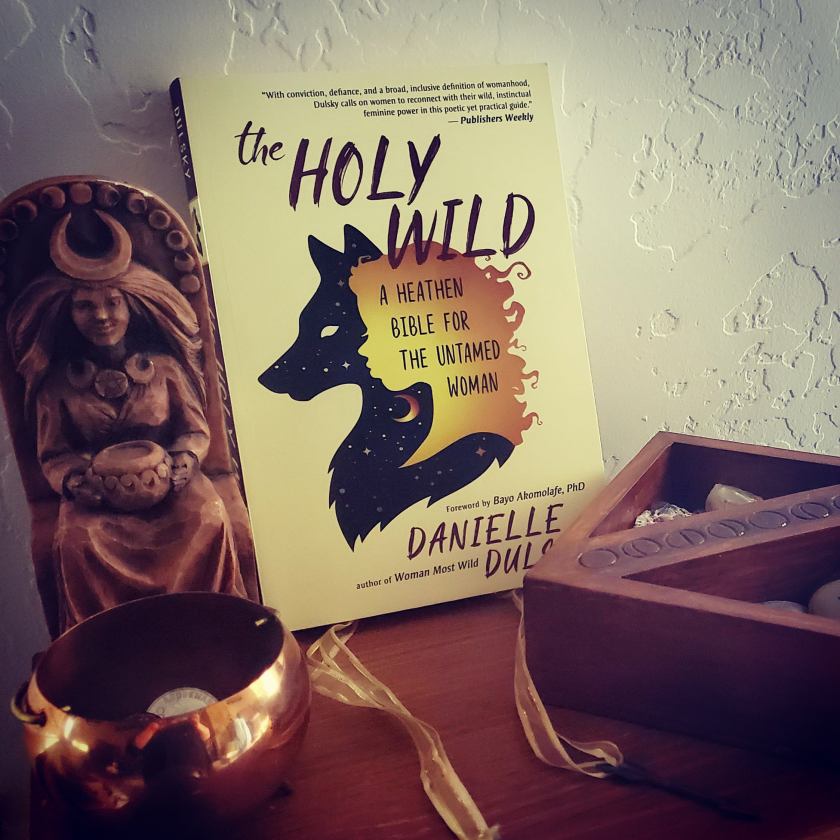
[Witchy Review] “The Holy Wild” by Danielle Dulsky

Full Title: The Holy Wild: A Heathen Bible for The Untamed Woman
Author: Danielle Dulsky
Published: September 2018 by New World Library
Genres: Nonfiction, Wicca, Gaia-based Religions, Comparative Religion, Spirituality
Edition Details: 304 pages, trade paperback
Source: Purchased
Rating: 3.5/5 stars

First Glance

To be candid, I bought this book based on the cover. My mate and I have matching hoodies with that wolf-woman image on it, and I couldn’t resist taking a closer look at a book with the same art on the cover. Since it was in the New Age section, I took a chance and grabbed it without looking up reviews or skimming the contents.

Positive Bits

Right off the bat, let me applaud Dulsky for how easily equality slipped into the story. Even though the title would imply this book is focused on cisgender folks, she immediately makes it clear (less than a dozen pages in) that she chose to emphasize the pronoun She/Her while seeing that divinity as “irrefutably pan-gender”. Again and again, she makes it clear that all feminine-leaning folk are welcome, regardless of physical form, to include mentioning their ability to use a Prayer for the Energetic Womb without having a physical womb (as it is about the energies of creation). This isn’t a common practice in books, which are either actively cisgender in their focus or passively so.

The writing portions throughout the book encourage you to write your own mythology, and to recognize the God-Goddess-Mystery within yourself in each story. As a writer myself, I find guided journaling to be an important tool for spiritual growth. The appendix at the end includes further questions and meditations to ponder, all of which fit in nicely with the path she outlines throughout the book.

I think there’s a lot of beauty in the poetic-prose Dulsky used to tell her tale. She built the book to be used out of order, and it shows in the way she allowed each elemental section to stand alone in its own story.

Less Enjoyable Bits

As someone who has never been a Christian, I have a hard time connecting to biblical stories. Unfortunately, the main myth that’s retold in each section is based on a feminine figure from the Bible. Salome, Mary Magdalene, Lilith – they all have interesting pasts and are retold with a beautiful shift to the focus of each story, but I’m not familiar enough with the Christian mythos to really connect with them on the level Dulsky likely hoped I would.

Another issue came in the form of an unexplained reference to “the Red Road”. After getting about 50 pages in, I finally looked onto for what she might be talking about. I assumed it was Christian, but it actually comes from a loose interpretation of various Native American beliefs. Considering how often it came up, I’m surprised to say she never explained it from start to end.

I don’t think this book is made to be read in one sitting. I read it all at once, and the poetic-prose became a little foggy after too much flowery imagery. If you read it in pieces over a few days, though, I think that’d be mellowed out to something more enjoyable.

Tidbits Worth Repeating

I am sucking the poison of patriarchy and privilege out of the soil and spitting it moonward, for these are the dire days of the fallen kings and raising queens. – page 44

There are few things in this world that cause more anguish than realizing that you are not who you thought you were, and, quite often, such a realization comes on the heels of a great wounding. The sword of the Dark Goddess hits us in the belly, the seat of our sense of self, and forces us to release the parts of our outward identities, the masks we show the world, that have become restrictive to our souls, the truest parts of ourselves. – page 130

The skeleton of any spell is formed from intention and energy raising, with its specific shape, the flesh laid over the bones, sculpted from the infusion of energy into the intention. – page 193

Is it worth the coin?

Yes(ish) – if you’re looking for a guide on exploring your ties to divinity and your personal mythos, I think this is a great starting point. If you’re looking to explore goddess worship, I’d find a simpler and more focused resource.

Posted in [witchy reviews]

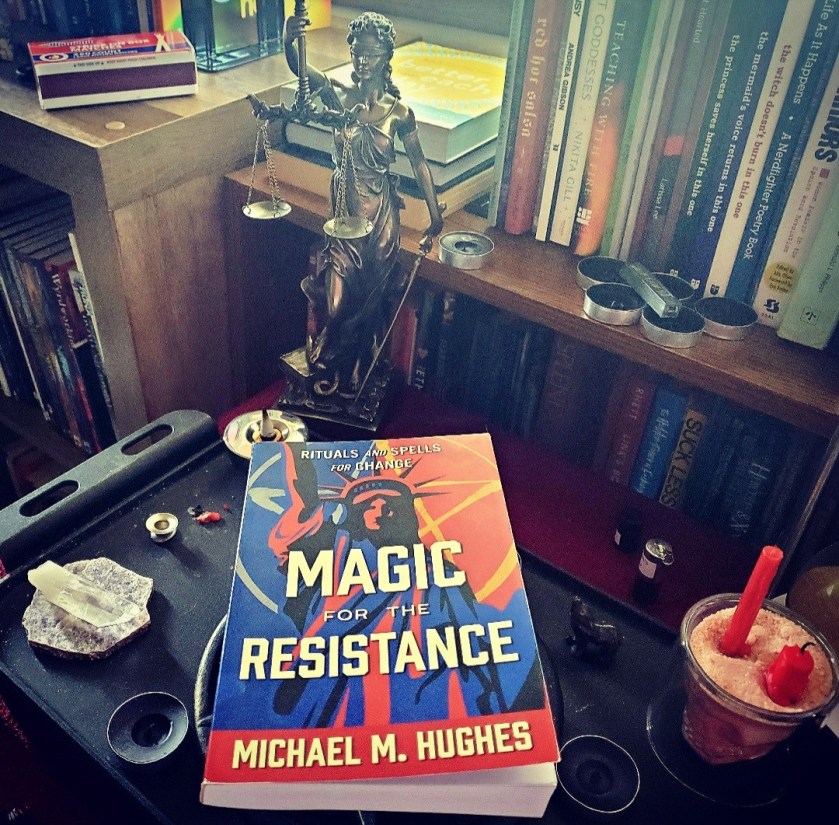
[Witchy Review] “Magic for the Resistance” by Michael M. Hughes

Full Title: Magic for the Resistance: Rituals and Spells for Change
Author: Michael M. Hughes
Published: September 2018 by Llewellyn Publications
Genres: Nonfiction, Human Rights, Magic Studies, Occult, Witchcraft
Edition Details: 264 pages, trade paperback
Source: Purchased
Rating: 4/5 stars

First Glance

In light of the social and political turmoil following George Floyd’s death, I mentioned to my wife that I had a list of witchy books related to activism and magic resistance. I had originally started a wishlist based on several Patheos posts. When she asked me why I hadn’t purchased any of them yet, I didn’t have a good reason. Half a dozen books were ordered immediately, and this was the first to arrive.

Positive Bits

To start, I appreciate the author’s choice to include a large section on the history of magic and activism before touching the magic itself. I think context is key to understanding magical workings, and the added knowledge gives additional strength to your magic. It was also interesting to note that he was the creator of the “Bind Trump” ritual that went around in 2017 and hit the major news networks. I had no idea!

The histories presented are done so in an entertaining and informative way, and I appreciate that sources are listed as footnotes. Some of the events are familiar, if only in a word-of-mouth kind of way; however, I like to look up details on events, particularly if they sound outlandish and have no specific sources.

In the section that includes spells and rituals for your magical activism, the variety provided allows for a “different strokes, different folks” approach. In fact, more of the rituals lean toward what I would call generally pagan or Wiccan-flavored than I expected, considering the author’s description of his own spiritual path and history. However, I found the less delicate options (like the spells “Calling Bullshit” and “Hex the NRA”) fit the more offense-vs-defense attitude the book seems to suggest. There’s a good balance.

I’ve personally set aside notes on a couple of projects for upcoming moon workings, so I definitely gained some ideas from this book that I didn’t have before. I’m glad this book was written to be so approachable, even from a non-witch perspective.

Less Enjoyable Bits

No book is perfect. I’ll admit that part of my issues stem from differences in paths. The author made it clear that he’s not a witch or pagan, but rather a magician with a relaxed attitude toward methods of magic. In some cases, you can see the ceremonial magician leanings, particularly when he tells you to do a thing, but then tells you “it just works, not sure why”.

When my previous training covered some basic ceremonial magic, we were told the same thing: if you follow the instructions, with or without belief, you will get the results. Actions matter more than intent. That never really worked for me, considering how often we’re told that intent matters more than tools, herbs, and stones – because we’re the source of magic, and they’re just a focus.

Unfortunately, the author gets a little preachy in the middle as he discusses “Self-Care and Resilience” and “On the Casting of Circles”. I don’t mind someone suggesting a no-kill fast for magical purposes, but implying that your magic will be negatively impacted by eating animals is a step too far. (To be fair, he does say to “trust your intuition and what your body tells you”.)

When we get to the section on casting circles, he dismisses the entire process without discussing the benefits of a circle; clearly, he has a hard preference for no circles in magic. He then immediately follows that dismissal with a watered-down ceremonial magic circle that takes up several pages of instruction, rather than anything familiar from witchcraft and circle casting methods in general. I feel as though the pages of complaint against circle casting are a product of the author’s experience in ceremonial magic and its structures. To each their own?

Tidbits Worth Repeating

A good rule of thumb to use is this: Would you endorse a legal action to stop the target’s harmful actions or policies (say, against a minority group, a forest, or a person unjustly accused of a crime)? If so, then a magical action is absolutely ethical. – Page 7

The more you do magic, the more possibilities you see for its use. Always look for ways to blend your magical workings with your practical activism. – Page 118

Now light a candle and get to work. – Page 222

Is it worth the coin?

Yes – I think this is a good place to start, if you’re wanting to use your magic as part of our activism. The overall accessibility of the spells and rituals makes it ideal for a beginner in this kind of work.

Posted in [fiction reviews]

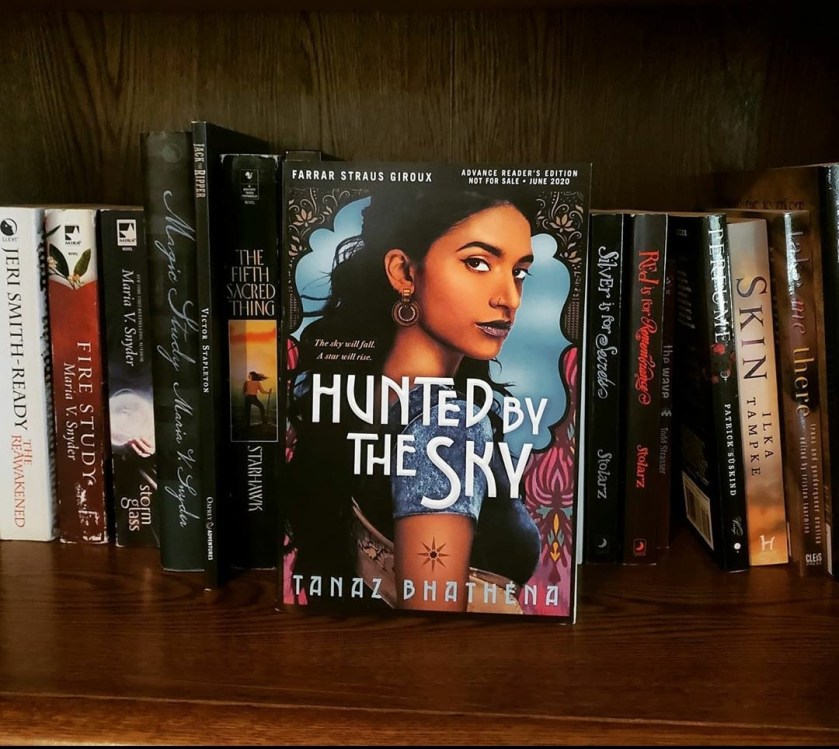
[Fiction Review] “Hunted by the Sky” by Tanaz Bhathena

Full Title: Hunted by the Sky
Author: Tanaz Bhathena
Published: Upcoming Release Date – June 23, 2020 by Farrar, Straus and Giroux
Genres: Young Adult, Epic Fantasy, Science Fiction & Dystopian Romance
Edition Details: 384 pages, Hardcover
Source: {Advance Readers’ Edition}
Rating: {4.5/5 stars}

This is a spoiler-free review. No details will be shared from the storyline itself that aren’t available or inferred from the book jacket and online descriptions.

First Glance

The gods of reading took pity on me, and I once again found a book in my Facebook feed. Fierce Reads promoted this novel via ads that allowed viewers to request an advanced readers’ edition. After reading the description, I had to take a chance:

Gul has spent her life running. She has a star-shaped birthmark on her arm, and in the kingdom of Ambar, girls with such birthmarks have been disappearing for years. Gul’s mark is what caused her parents’ murder at the hand of King Lohar’s ruthless soldiers and forced her into hiding to protect her own life. So when a group of rebel women called the Sisters of the Golden Lotus rescue her, take her in, and train her in warrior magic, Gul wants only one thing: revenge.

Cavas lives in the tenements, and he’s just about ready to sign his life over to the king’s army. His father is terminally ill, and Cavas will do anything to save him. But sparks fly when he meets a mysterious girl—Gul—in the capital’s bazaar, and as the chemistry between them undeniably grows, he becomes entangled in a mission of vengeance—and discovers a magic he never expected to find.

Dangerous circumstances have brought Gul and Cavas together at the king’s domain in Ambar Fort…a world with secrets deadlier than their own.

Added to that, the book is specifically mentioned that it explores identity, class struggles, and a world inspired by medieval India. I couldn’t resist!

Positive Bits

As someone who enjoys YA, I still find myself frustrated by characters who act a little too immature or naive. Thankfully, Gul and Cavas (the main characters of our story) manage to find that balance between youthful folly and energetic luck.

The chapters pivot between the viewpoints of Gul (female) and Cavas (male), which is one of my favorite methods of telling a multi-POV story. We even get a chapter at the end in the POV of an antagonist who will obviously be around for book 2.

The magic and beings in Ambar are built well, obviously steeped in a familiarity with mythology and a heavy dose of creativity. I admire the way Bhathena sketch out our experience, using a first person POV to allow us to really experience each location ourselves.

I love a good revenge scheme, especially if nothing goes according to plan. I won’t say more, as I’m not willing to share any spoilers, but I enjoyed being wrong about where the story takes us.

Less Enjoyable Bits

Some of the side characters should’ve been given more depth, in my opinion. The story isn’t made less by their flatness, but I think it could’ve been made even richer if we saw more of those people.

For example, the three main people Gul interacts with from the Sisters of the Golden Lotus are slightly 3-D, but I found myself disappointed to not get more out of their backstories and actions. We get bits and pieces, enough for their presence to make sense and be important, but we don’t get a full picture of their character.

I also wish more characters were given depth, largely because that tends to leave you wondering who is important to the plot. It’s not essential, but I prefer a little less lead-by-the-hand reading. When there are multiple fleshed out characters, you end up guessing (and sometimes being wrong about) who will play a key role in the story. When only a handful of specific people get full descriptions, you know they’re the important players and all of the guess work is lost. (Again, that’s a personal preference.)

Tidbits Worth Repeating*

* Without spoiling the plot, but giving you a taste of the mood…

“You have to eat sometime, princess.”

I look up from the plate full of lotus sabzi, dal, and rice and into Amira’s dark eyes.

“No one cares, do they?” I ask. “About girls like us.”

Something shifts in her gaze, something I don’t quite understand. “Eat,” she says again before leaving the room.

I don’t.

One kindness for another, the mammoth tells me as I cling to it. You did not let me die in the market; I will not let you fall.

Do not judge yourself too harshly, Savak-putri Gulnaz. Subodh’s voice feels like a gentle breeze in my mind. I am older than you are and have made mistakes that are even bigger. There are always ways to make amends. 

Is it worth the coin?

Yes! I recommend this book if you like big worlds based on various real world cultures (other than European). I’ll be keeping an eye out for book 2.

Posted in [writer resources]

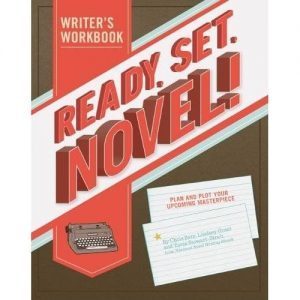
[Resource Review] “Ready, Set, Novel!” by Chris Baty, Lindsey Grant, and Tavia Stewart-Streit

Full Title: Ready, Set, Novel! Plan and Plot Your Upcoming Masterpiece
Author: Chris Baty, Lindsey Grant, and Tavia Stewart-Streit from National Novel Writing Month
Published: October 2011 by Chronicle Books
Genres: Nonfiction, Books & Writing, Writing Fiction, Authorship, Writing Skills
Edition Details: 160 pages, trade paperback
Source: {Purchased – New}
Rating: {4/5 stars}

First Glance

Woohoo! It’s a NaNoWriMo workbook! I love workbooks!

In all seriousness, this was the last NaNoWriMo-specific book on my list. I mostly bought it to complete the NaNoWriMo mini collection.

Positive Bits

The NaNoWriMo team really did create a workbook for writers that fits the formatting of the event itself. These are the hands-on activities I said were missing in the previous books; in fact, I’m surprised they didn’t make a combination set somewhere along the way.

I love the playful attitude of this workbook. There’s a page that’s literally a high five, and you’re supposed to celebrate your successes by slapping the hand on the page. There’s also a boot for your “kick in the pants” as needed. Silly, but cute!

For a newbie writer with little or no experience with creating characters from scratch, I think the activities focused on that process are particularly helpful. When I was younger, I basically kidnapped the personality of people close to me (while changing their names). The workbook gives you more thorough activities for character building.

Less Enjoyable Bits

I’m not sure this book is useful if you’ve written multiple stories in the past. Many of the activities are super simplified processes that you internalize as you grow, and that makes this workbook feel less helpful than I’d hoped it to be.

Workbooks, by their very nature, have little actual writing in them. There’s tons of blank space for the person actually doing the work. That said, I sprinted through this book and found myself disappointed at how short it was outside of the times you were supposed to pause your reading and do an exercise.

It’s a silly complaint, but I prefer workbooks that are bound in a way that allows easier use. The spine on this book (while new) is very stiff, so actually writing in the workbook itself would be irritating until you broke it in. There’s not much to do about that, though, unless the publisher wanted to use the thinner paper and binding of a traditional school workbook instead of trade paperback binding methods.

Tidbits Worth Repeating*

*Note: I didn’t have a lot of quote to share, because this workbook is mostly a collection of exercises that don’t lend themselves to epic quotability.

The hardest part is behind you. Your story is here. Your characters are waiting. It’s time for the next phase of this bookish adventure to begin. You ready? You’re set. Let’s novel. {page 117}

Is it worth the coin?

Yes – particularly for new writers. If you benefit from surfing Tumblr or Pinterest for character creation tips and the like, then this book has a decent collection of worksheets to help you out. This workbook would also be a great help with pre-planning your novel, doing the outlining and world building required to get started.

Posted in [writer resources]

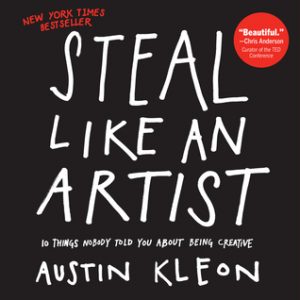
[Resource Review] “Steal Like an Artist” by Austin Kleon

Full Title: Steal Like an Artist: 10 Things Nobody Told You About Being Creative
Author: Austin Kleon
Published: February 2012 by Workman Publishing
Genres: Nonfiction, Arts & Photography, Art Therapy, Study & Teaching
Edition Details: 160 pages, trade paperback
Source: {Purchased – Used}
Rating: {3.5/5 stars}

First Glance

I ran across this book in the thrift store, tucked between old textbooks and random nonfiction. I didn’t have to read more than a couple of points from the back cover before I decided to purchase it. Why? Because the back cover is a numbered list, and #3 says “Write the book you want to read.” (That’s my favorite piece of writing advice.)

Positive Bits

This book is a ridiculously quick read. I finished it all in one lunch break (less than an hour), and I didn’t skip or skim anything. The artsy visuals throughout really make the ideas presented in the text quick and easy to conceptualize.

There were so many good nuggets of information! One of the best things about Kleon’s tips is that they were applicable to any kind of creative effort. While I enjoy a good writer’s guide, I like to think that creativity isn’t so narrowly focused that we have to read ONLY writer’s books or ONLY photography blogs. Creativity’s core focus is to create. Anyone who embraces that idea is alright with me.

Kleon had many functional ideas that fit with habits I already have. For example, he tells you to collect books even if you don’t intend to read them immediately. I’m a proud bookdragon, and my hoard is wonderous! He also reminds us to collect praise as much as we collect critiques, because there will always come a time when you need a reminder about why you write in the first place. My own “praise file” includes messages from a boy and his mom, asking to use one of my poems for a presentation in school. It still makes me smile!

Less Enjoyable Bits

There’s an entire section that speaks against the use of computers (or digital creativity methods in general). As a digital native, my creativity is enhanced by using electronics. I can type faster than I can handwrite! One valid point was that the temptation to delete the things you create and hate is too great (oh god, like that rhyme!) when all it takes is a click. But it only took a week or so of actively practicing the habit of NOT deleting anything I wrote to remove that temptation from my writing habits. [link to blog post about this here]

Kleon also talks about the disconnect an artist feels from things created on a glass screen… but I don’t experience that problem. Sure, I love a good printout of my newest story or poetry collection, but I can still sit in awe of a digitized piece with a wordcount beyond my starting goals. I guess I just take issue with anyone who disses the digital and insists that “old school” or “hands on” is the ONLY way to art. If you browse the photomanipulation section of a site like deviantART [link?], you’ll see why that attitude needs to head out the door. Digital is just a new medium, that’s all.

In a weird way, this book was almost too short. There’s a second book called “Show Your Work” [get full title details] that sounds interesting, but I think they could’ve easily been one book instead of two. Then again, I could be wrong and the information could be incompatible. I haven’t read the other book, so I can only go by the description.

Tidbits Worth Repeating

(1) Steal like an artist.
(2) Don’t wait until you know who you are to get started.
(3) Write the book you want to read.
(4) Use your hands.
(5) Side projects and hobbies are important.
(6) The Secret: Do good work and share it with people.
(7) Geography is no longer our master.
(8) Be nice. (The world is a small town.)
(9) Be boring. (It’s the only way to get work done.)
(10) Creativity is subtraction.
{back cover}

We make art because we like art. We’re drawn to certain kinds of work because we’re inspired by people doing that work. All fiction, in fact, is fan fiction. The best advice is not to write what you know, it’s to write what you like. Write the kind of story you like best – write the story you want to read. {page 47}

Remember “garbage in, garbage out”? You’re only going to be as good as the people you surround yourself with. In the digital space, that means following the best people online – the people who are way smarter and better than you, the people who are doing the really interesting work. Pay attention to what they’re talking about, what they’re doing, what they’re linking to. {pages 102-104}

Is it worth the coin?

Maybe – but I think it’s too shallow on the topic of creativity to be worth the published price.

Posted in [writer resources]

[Resource Review] “Create Your Writer Platform” by Chuck Sambuchino

Full Title: Create Your Writer Platform: The Key to Building an Audience, Selling More Books, and Finding Success as an Author
Author: Chuck Sambuchino
Published: November 2012 by Writer’s Digest Books
Genres: Nonfiction, Web Development & Design, Social Media, Business Technology
Edition Details: 248 pages, trade paperback
Source: {Purchased – Used}
Rating: {4/5 stars}

First Glance

It’s going to sound silly as I write out a blog post that will be shared across various social media channels, but… this book had me both intrigued and a bit leery. I’m not into the Influencer culture, the idea of success being measured by social media reach. However, I recognize that I follow people I like online; they’ve built the kind of communities and online interactions that leave you feeling good when they’re done. So clearly, a writer can benefit from using social media to interact with their readers, other writers, and the bookdragons of the world at large.

Positive Bits

Sambuchino made a lot of sense in his instructions. He gave concrete measures for recognizing successful social media platform creation, rather than generalizing. I like numbers and goals; it’s part of why I like NaNoWriMo’s 50K in 30 days, because it’s a concrete goal and timeline. This book has many examples of ways to track your platform growth.

My favorite suggestion (with tangible focus) was to Google yourself. If you’re the majority of the first page results, then you’re doing it right when it comes to social media and building a platform. I’ve done it, and my years of blogging and sharing poems have led to a large number of my posts coming up in Google Images in particular. It’s kind of neat!

I also appreciated the recognition of how important community can be. You don’t have to be a writer all alone; in fact, online writing groups can be ridiculously helpful in giving you inspiration, constructive criticism, and opportunities to give back.

Less Enjoyable Bits

A large portion of the advice in this book focused on the kinds of writers who want to run in certain circles. The authors who give paid speeches in various conventions and college events. The writers who become a household name in their field.

The focus made on networking made sense, but sometimes it pushed the boundaries of realistic choices for a person to make. For example, Sambuchino mentions working in your desired field (in relation to nonfiction writers) even if it means accepting a pay cut. That’s not terrible advice… except people who are already scraping by paycheck to paycheck can’t just switch jobs for fun. No one needs to actually choose to become a starving artist to succeed.

I felt like the section on Facebook usage was oddly out-of-date for such a recently published book. I’ve had pages for various groups and topics over the past decade, and you don’t have to friend people to interact with them on a page you manage. So the entire description of how to use Facebook effectively was out of sync with the reality of Facebook.

Tidbits Worth Repeating

You don’t have to go it alone.

Creating a large and effective platform from scratch is, to say the least, a daunting task. But you don’t have to swim out in the ocean alone. You can – and are encouraged to – work with others. {page 40}

You can only best understand and help members of your niche/community if you’re heavily involved with them. Your goal is to join and participate in any kind of community that links you with those who share your interests – and by participate I’m talking meaningful interaction, not status updates on Facebook that tell people to buy your book. {page 66}

Create content with passion and gusto, and build a community around yourself. The goal is simply to create a huge readership and to help that some of that visibility translates to book sales. No double it will, though exact numbers will be difficult to come by. {page 84}

Is it worth the coin?

Yes – if you don’t know where to start with social media and all the online mumbo jumbo associated with marketing yourself and your writing. Be warned, though, that this book is largely focused on how a nonfiction writer gets attention. The tips and tricks can crossover, but they don’t always translate into fiction work.

Posted in [fiction reviews]

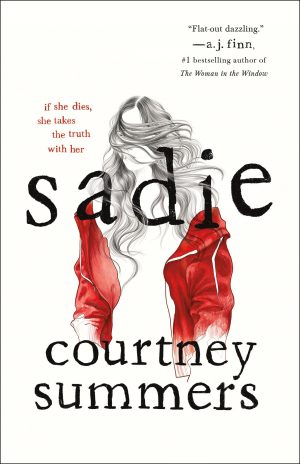
[Fiction Review] “Sadie” by Courtney Summers

Full Title: Sadie
Author: Courtney Summers
Published: Upcoming Release Date – September 4, 2018 by Wednesday Books
Genres: Young Adult, Fiction, Thriller, Mystery, Suspense
Edition Details: 320 pages, hardcover
Source: {Advance Readers’ Edition}
Rating: {4.5/5 stars}

This is a spoiler-free review. No details will be shared from the storyline itself that aren’t available or inferred from the book jacket and online descriptions.

First Glance

I actually ran across this book in my Facebook feed, as an ad that asked interested readers to sign up for a copy. Mind you, I assumed it’d be a drawing for a handful of lucky people. Instead, I got an email telling me to be ready for my copy to arrive in the mail!

That said, I will point out that I didn’t request a copy just because I wanted a free book. I was intrigued by the first lines I read about Sadie:

I’m going to kill a man.

I’m going to steal the light from his eyes.

I want to watch it go out.

You aren’t supposed to answer violence with more violence but sometimes I think violence is the only answer.

Positive Bits

As someone who normally reads romance and fantasy novels, I wasn’t sure a thriller (YA or not) would be up my alley. I was wrong! The pace and storyline are set in such a way that I think almost anyone could enjoy it. After all, my main complaint against thrillers and true crime stories is usually related to an overabundance of graphic detail; Summers managed to avoid that without minimizing the core crimes at play in this plot.

I’m a sucker for interesting new ways to tell a story. In Sadie this plays out in a pattern of interwoven podcast scripts and chapters in Sadie’s perspective (written in first person). It kept me tied up in the story without having to give me too many nitty gritty details all at once. It actually reminded me of episodes from true crime shows, where the narrator gets you interested and then they reenact different sections of their story as the episode plays out.

I’ll be honest. This book is the kind of story that I personally end up hate-reading. Like, I absolutely despised what was happening, but I had to know how things turned out. I love a story that’s strong enough to drag you in against your will and make you stay.

Less Enjoyable Bits

There were times I was a little frustrated with the limitations of a Sadie POV scene, because it would end abruptly and not pick up at the same point the next time we rejoined her. Most of the switches were spaced in acceptable moments of flux, like getting back on the road or getting a new piece of information. But one or two just seemed to leave the reader hanging for no good reason.

I’m trying not to give any spoilers, so I’ll just say this. Even a well-written story about a bad man doing bad things to people involves a bad man doing bad things to people. It turns your stomach, as it should. Nothing was graphic, but as a reader less accustomed to thrillers and their bookish kin, parts of the story made me uncomfortable in a way I’m not used to experiencing.

My last note? I like my stories to end with every single string of plot tied into a tidy knot. But that’s a personal preference.

Tidbits Worth Repeating*

* Without spoiling the plot, but giving you a taste of the mood…

Girls go missing all the time.

Restless teenage girls, reckless teenage girls. Teenage girls and their inevitable drama.

West McCray [Studio]:

I spent the weekend with my daughter and she could tell something was wrong. I didn’t want to let her out of my sight, but at the same time, I almost couldn’t bear to look at her.

But love is complicated, it’s messy. It can inspire selflessness, selfishness, our greatest accomplishments and our hardest mistakes. It brings us together and it can just as easily drive us apart.

It can drive us.

Is it worth the coin?

Yes – if you’re into thrillers and crime shows. I wouldn’t read this book again, at least not the same way I read and reread my favorite romance stories. But I’m definitely recommending this book to my wife, whose growing collection of true crime novels could use a new addition.

Posted in [writer resources]

[Resource Review] “The Kick-Ass Writer” by Chuck Wendig

Full Title: The Kick-Ass Writer: 1001 Ways to Write Great Fiction, Get Published, & Earn Your Audience
Author: Chuck Wendig
Published: November 2014 by Writer’s Digest Books
Genres: Nonfiction, Writing Skills, Authorship, Creative Writing & Composition
Edition Details: 282 pages, trade paperback
Source: {Purchased – Used}
Rating: {3.5/5 stars}

First Glance

I’d seen Pinterest pins of various quotes from this book, particularly during the NaNoWriMo season. Considering his mouth (foul words and verbal slaps in the face), I knew I’d likely be both amused and annoyed with Wendig’s style.

Positive Bits

I love lists! A list forces a writer to be concise and to really make sense of their thoughts. Listmaking is one of my favorite writing tools, both for vague story outlines and for stretching my creative writing muscles.

Between the jokes and silly metaphors, Wendig built a legitimate collection of writing tips I think any author could benefit from. Actually, I love the fact that the book’s lists make quoting Wendig’s points so easy! After all, every statement is numbered.

Wendig’s voice is approachable. There is no master-student dynamic in this book. Instead, he gives you that smartass friend who’s telling you all about his opinions. If nonfiction usually bores you to tears, it’s likely due to a teacher’s tone being used throughout the text. Some people just learn better from peers.

Less Enjoyable Bits

One list is fun. A dozen lists can still be entertaining. But 282 pages of lists? I’m sure it made writing the book itself much easier, but lists with the exact same format can get a bit mind-numbing.

Wendig ended up with a lot of repetition and contradiction between his lists. For example, he discussed how a plot generally needs a beginning, middle, and end on a list only to repeat that point again on another list a few pages later (maybe with a new joke). At the same time, he’d mention how you have to know how the story ends, except that you don’t have to know until you get there, but be sure to write the ending first, unless you don’t. It was a little frustrating.

I think that Wendig’s humor is best ingested in small amounts, like rich chocolate cake. Too much, and you just get sick of it. To be fair, though, I expected to end up feeling this way by the end of the book; I follow his blog, so I’m well aware of his voice and how I react to it.

Tidbits Worth Repeating

Stop Running Away: Right here is your story. Your manuscript. Your career. So why are you running in the other direction? Your writing will never chase you – you need to chase your writing. If it’s what you want, pursue it. {page 53}

Stories Have Power: Outside the air we breathe and the blood in our bodies, the one thing that connects us modern humans today with the shamans and emperors and serfs and alien astronauts of our past is a heritage – a lineage – of stories. Stories move the world at the same time they explain our place in it. They help us understand ourselves and those near to us. Never treat a story as a shallow, wan little thing. A good story is as powerful as the bullet fired from an assassin’s gun. {page 21}

[On why you write] You do it because you love it. You do it because you want to be read. You tell stories because you’re a storyteller. And because stories matter. {page 277}

Is it worth the coin?

Yes – but check out his blog terribleminds first to get a taste of his style. I’m not sure I’d purchase this book full price, but seeing it on a used shelf for a few bucks? Sure. To each their own preferences.

Posted in [writer resources]

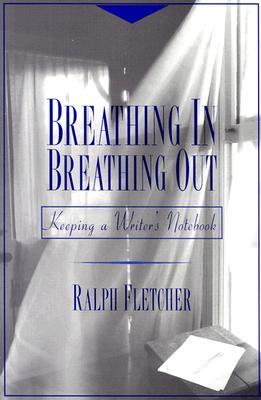
[Resource Review] “Breathing In, Breathing Out” by Ralph Fletcher

Full Title: Breathing In, Breathing Out: Keeping a Writer’s Notebook
Author: Ralph Fletcher
Published: November 18, 1996 by Heinemann
Genres: Nonfiction, Reference, Studying, Language & Grammar
Edition Details: 112 pages, trade paperback
Source: Purchased – Used
Rating: {3/5 stars}

First Glance

Approaching this book, I made special concessions to its age. Written in 1996, this book was guaranteed to use a different style and voice than modern writing guides; after all, it’s over two decades old!

That said, it surprised me that the book is labeled for ages 5-17 on Amazon. Skimming through the pages, I wouldn’t think of it being aimed any earlier than middle or high school. Maybe a teacher could translate it for easier use?

Positive Bits

As someone who uses a digital journal (outside of this blog) to ramble on and on, Fletcher’s ideas about how to develop a writer’s notebook validate my own practices. It’s one thing to know a process works for you; it’s another to have someone else give you multiple examples of famous authors who do the same process for the same reasons.

I’ve always had a hard time at conceptualizing a writer’s notebook as a whole. I have Pinterest boards with writing quotes and story prompts, but they’re separate from my Google Drive folder of story ideas and scene snippets. While I prefer a digitized “notebook”, Fletcher’s explanations and examples left me intrigued enough to consider switching (at least in part) to a physical notebook.

The sections break the idea of a writer’s notebook into manageable pieces. I appreciate how often he reminds us to play with words until they come naturally, especially in the beginning.

Fletcher’s personal samples of older writings are painful… and yet painfully familiar! We all stumble through writing while we find our voice. One of the challenges (and joys) of looking at our older writings is finding the recyclable ideas among the rubbish.

Less Enjoyable Bits

I didn’t connect to Fletcher’s voice. From the start, I struggled to make myself read more than a handful of pages at a time. For such a short book, it took me two (2!) whole months to finally get to the end.

Fletcher is clearly a poet. We often get caught up in metaphors and imagery when it’s less than helpful. I feel like many of his chapters were weighed down by odd amounts of poetic prose and awkward word choice.

He turned me off when he started complaining about writing prompts and those who swear by them. It felt too much like writer’s elitism, like he’s just too good for such trivial writing exercises. (To be fair, Fletcher moved past that later in the same section, but the impression lingered.)

Tidbits Worth Repeating

Writing puts you in a state of ‘constant composition,’ and this is particularly true of writing in a notebook. Regular notebook writing acts as a wakeup call, a daily reminder to keep all your senses alert. This starts a cycle that reinforces itself. Writing down small details gets you in the habit of seeking out the important small things in your world. These details in turn often lead you to new material you never knew you had. {page 19}

It’s not that I try to write badly in my notebook. But I know I will be doing exactly that, just like countless other writers before me. If you read the notebooks of famous writers you’ll find some wonderful writing, sure enough, but you’ll also find pages and pages of stuff that is surprisingly boring and tedious. In a strange sort of way I find this comforting and even inspiring. {page 56}

The notebook is the place to take care of the writer inside you. To keep the writing flame lit amid the winds of indifference. This is important because nobody else will care about your writing as much as you. {page 84}

Is it worth the coin?

No – at least not at the prices I’ve seen online. The list price is $25, but even the cheaper (used) options are about $6 after shipping. I bought this book used on a dollar book day at our local Half Price Books, so it was probably worth the buck.

Posted in [writer resources]

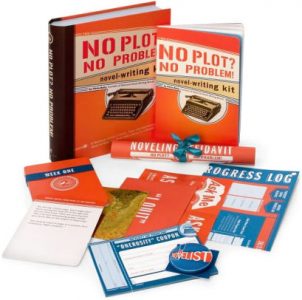
[Resource Review] “No Plot? No Problem! Novel-Writing Kit” by Chris Baty

Full Title: No Plot? No Problem! Novel-Writing Kit: A Treasure Chest of Tools, Tips, and Righteous Gear to Help You Bash Out a Novel in a Month
Author: Chris Baty, Founder of National Novel Writing Month
Published: September 2006 by Chronicle Books
Genres: Nonfiction, Writing & Books, Authorship, Writing Skills, Writing Fiction
Edition Details: 48 pages, trade paperback – kit also includes a calendar, daily inspiration cards, coupons and peptalk letters, and the Radiant Badge of the Triumphant Wordsmith
Source: {Purchased – New}
Rating: {5/5 stars}

First Glance

I know I reviewed the original NaNoWriMo book, but I happened to get this kit on clearance at Barnes & Noble somewhere along the way as well. I’ll be brief, as there are few thoughts about this kit that don’t align with my review of the 2004 book.

Positive Bits

Humor is still Baty’s key approach, and it fit well with the pacing of this smaller kit’s book. The activities mentioned as similar to those in the core book, but this kit focuses on the basic details and leaves the actual accomplishment of each activity up to the writer.

I enjoyed the titles and descriptions of people who you might invite to join you. Instead of just suggesting family and friends, Baty takes the time to explain archetypes for each kind of person. A fellow writer. A challenge taker. A book group(ie).

Less Enjoyable Bits

Honestly, there’s a clear echo. The mini book in this kit would easily take the place of purchasing the full No Plot? No Problem! if you were choosing between A or B. You’re losing the history of NaNoWriMo and some depth to the exercises offered, but the basic explanation and guidance for writing a novel in a month are still present.

However, this kit really is the bare bones of NaNoWriMo guidance. It’s good… but not very different from just reading bits and pieces of the peptalk emails you get from NaNoWriMo’s website during November.

Tidbits Worth Repeating

The Radiant Badge of the Triumphant Wordsmith {throughout}

I just really love the over-the-top name! Maybe I should add that to my resume…

Is it worth the coin?

Yes – I think the kit has been on the clearance shelves of Barnes & Noble for the past year or so. But even at full price, this kit is just playful enough to get you going on your NaNoWriMo adventure. Also, there’s just something extra enjoyable about using a kit rather than just referencing a book.

Posted in [writer resources]

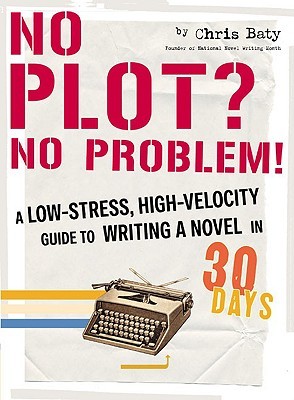
[Resource Review] “No Plot? No Problem!” by Chris Baty

Full Title: No Plot? No Problem! A Low-Stress, High-Velocity Guide to Writing a Novel in 30 Days
Author: Chris Baty, Founder of National Novel Writing Month
Published: September 2004 by Chronicle Books (apparently I got a used first edition)
Genres: Nonfiction, Writing &  Books, Authorship, Writing Skills, Writing Fiction
Edition Details: 176 pages, trade paperback
Source: {Purchased – Used}
Rating: {4.5/5 stars}

First Glance

Let’s be real. As someone who’s participated in NaNoWriMo for years, I was destined to enjoy this book. My only first glance impression was that my edition might be quite different from whatever’s being sold now (14 years later). Actually, my wife’s joked about buying me the newest 2014 expanded edition just so I can compare the two!

Positive Bits

Humor is often hit and miss. Baty found a good balance, I think, in using generalized jokes and dorky humor throughout the book, all without crossing the line into anything questionable (i.e. sexist, racist, ageist, etc.).

One activity I loved the idea of is the Magna Carta (and Magna Carta II). The short version is that you make a list of things you love in a story (I) and things you can’t stand (II). Those lists then serve as a guide when you feel a bit listless or lost in your plot. I’ve done this activity before (calling it “reader research”), and I think it’s a marvelous way to really discover both preferences and skills.

The language of this book (and concepts presented) never aim over the head of anyone who can read a chapter book. I think a middle schooler could get just as much use and enjoyment out of this book as their grandparent. Baty’s voice is conversational enough to make reading each chapter feel like a chat over coffee (or cocoa).

Less Enjoyable Bits

Every single time Baty directs the reader to take full advantage of company supplies or time, I cringe. Maybe that worked a decade ago, but many companies now record all emails sent and received (for legal reasons). Personal documents aren’t actually personal. So aside from the questionable ethics of not working at work, you have the reality that today’s companies will be far less naive about your digital activities (and printing). That said, a wireless keyboard and a smartphone can lend more honest opportunities to write on breaks and lunch (while avoiding company resources and time).

This book doesn’t include a lot of suggestions on your process itself. It covers the basics of your word count, your timeline, and then a weekly breakdown of how (he assumes) you’ll feel as the event goes forward. Small stories and side notes from previous NaNoWriMo participants help mediate this absence, but it still left me a little disappointed.

Baty wrote for non-writers. His pep talks and advice are ideal for them… and less useful for the rest of us. I think writers need a different approach, largely because we have a familiarity with the process that also makes us more nervous about success versus failure.

Tidbits Worth Repeating

The biggest thing separating people from their artistic ambitions is not a lack of talent. It’s the lack of a deadlineGive someone an enormous task, a supportive community, and a friendly-yet-firm due date, and miracles will happen. {page 14}

The things that you appreciate as a reader are also the things you’ll likely excel at as a writer. {page 86}

[Talking about people playing sports or videos games for fun on weekends, not to become famous] They do it because the challenge of the game simply feels good.  They do it because they like to compete, because they like spending time with friends, because it feels really, really nice to just lose themselves in the visceral pleasure of an activity. Novel-writing is just a recreational sport where you don’t have to get up out of your chair. {page 172}

Is it worth the coin?

Yes – I’d even buy this book at full price, and I rarely do that with any book. While I didn’t get as much active assistance from this book as I’d hoped, the history of NaNoWriMo and its bare bones fascinated me.

Posted in [book reviews], [fiction reviews]

Book Review: “Interfaced” by Emerson Doering

I vlogged my first book review! The book was Interfaced by Emerson Doering, an ebook that was on sale (i.e. free) when I found it. Pixel of Ink listed it on the daily deals post just a few weeks ago, I believe.

Rating on Goodreads: 4 stars

Would I recommend this book? Yes.

PROS: 
– I love the way the girl’s experiences are detailed, from her first experience moving toys with her mind to her eventual abilities after surgery. I also love the way we see the doctor’s issues with anger and fear. He has a legitimate panic attack while speaking in public, which we discover is largely based on a prior negative experience that included injury.

– I love the conspiracy that runs through the story.

CONS: 
– The author’s voice takes some getting used to, because he uses lots of partial sentences (like someone Southern is reading you a story). For a grammar fiend, it’s hard to get past at first. However, it’s clearly a style choice and not accidental errors.

– I dislike the epilogue; it’s too wrapped up in a bow and skips the emotions of adjusting to who’s died, what’s changed, etc. I like loose ends to be taken care of, but this epilogue just didn’t work for me.

– I absolutely hated the two boys (Pale Eyes and Adam?) that were eluded to repeatedly. I thought the main character had been raped, but it turns out to be non-sexual violence. I won’t ruin anything else, just know that they aren’t rapists.

– It was often hard to follow most action scenes visually, because too much was going at the same time. I’d lose track of who threw that thing over there, or exactly how someone was laying after falling to the ground.

Update (April 2020): While working to update my website and old reviews like this one, I discovered this book is no longer available online. The series itself has been pulled from Amazon Kindle, as far as I can tell.