Posted in [witchy reviews]

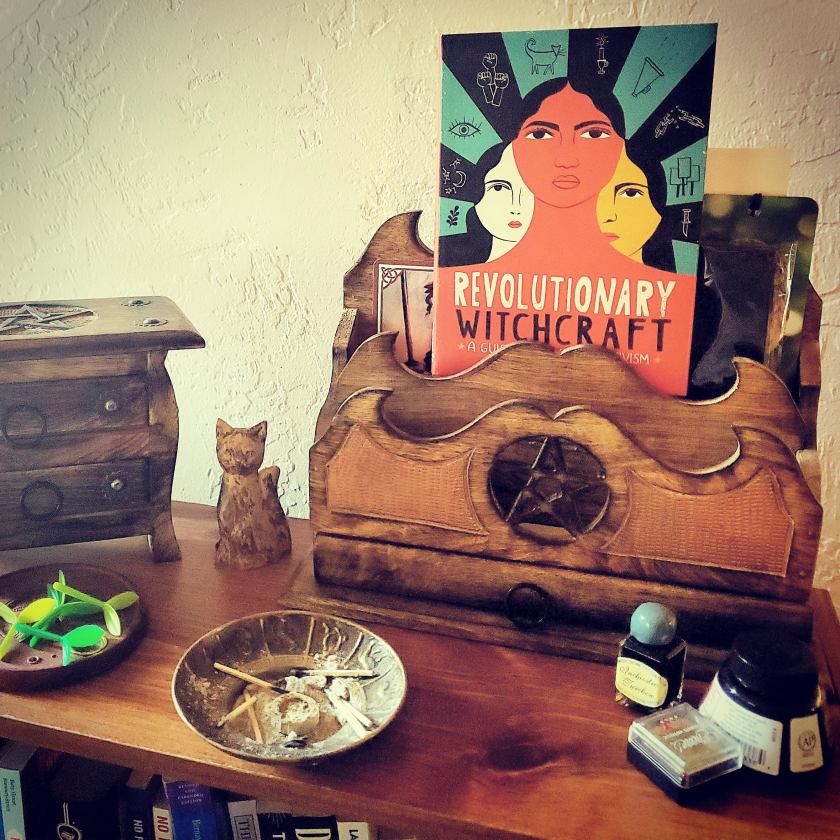
[Witchy Review] “Revolutionary Witchcraft” by Sarah Lyons

Full Title: Revolutionary Witchcraft: A Guide to Magical Activism
Author: Sarah Lyons
Published: November 2019 by Running Press Adult
Genres: Nonfiction, Women in Politics, Democracy, Occultism, Witchcraft, Social Justice
Edition Details: 168 pages, flexibound
Source: Purchased
Rating: {3/5 stars}

First Glance

With the Black Lives Matter protests against police brutality raging (rightfully) across the country, this book is part of half a dozen resources I decided to purchase. I’m working from home and fully self-quarantined for safety, but I wanted to make some kind of difference. Part of that has been a decision to put my magic where my mouth is, so to speak.

Positive Bits

The premise of this book is set from the start, that activism is a form of magical action. If magic is about directing power (energy) toward a goal, so is politics. There aren’t necessarily as different as you might think. That said, this book is clearly for direct and physical activism, rather than magical works. If you’re looking for a way to merge action with magic, then you’ll find it.

I appreciated the section on getting in touch with your ancestors, as the author took time to point out that ancestors of spirit (i.e. non-familial beloved dead) are valid. As someone from a small and scattered family, I don’t have the ability to trace back my bloodlines very far. However, there are elders that came before me who directly shaped me as a witch (like Scott Cunningham). With found family being such a bit part of both the witchcraft and LGBTQ+ communities, it’s nice to be reminded that it’s not always about blood.

The book also describes the reality of Trump as America’s Shadow. He’s the culmination of our darkest urges and realities, not an outlier. In discussing this, the author points out how unsurprised some oppressed groups were when Trump got elected; after all, when you spend so much time being mistreated by your country, the idea that there are enough people who think like Trump to elect him isn’t that far-fetched. I can definitely relate, as someone who lived as an LGBTQ+ witch in Texas for a decade… it’s exhausting to face the societal Shadow day in and day out, but some people don’t have the luxury of ignoring it.

In the ritual portion of the book (the appendix), the author explains how you can take premade spells and make them your own by localizing your magic. For example, you can look at the native plants in your area and figure out their magical associations. Once you have a list of local magical herbs, you can use them in place of hard-to-obtain or unfamiliar herbs in spells. Being tied to your area makes your magic more effective, because you’re literally harnessing your homeland (i.e. the land around your home) for assistance.

Less Enjoyable Bits

This book is not about witchcraft for the revolution. As mentioned in the Positive Bits, there’s an appendix of rituals and spells; however, there are only a handful offered and nothing particularly useful for those of us trying to help the activists from home. To be fair, the book was written in the pre-quarantine life we once had, but it was a disappointment to have the focus largely be on direct, in-person activist works.

Occasionally, the tone of the author is dismissive in places I found unpleasant. They brushed off the use of beauty products in a dismissive tone, ignoring the cultural aspects of cosmetics that have existed in mundane and magical life for centuries. They also brushed off deity worship in general. As someone who practices both animism and hard polytheism, I find it a bit disrespectful to dismiss gods and goddesses as a whole due to the vague belief that some worship Mother Earth as “a white woman with long hair and conveniently placed leaves”. The attitude is sporadic in a few topics rather than existing throughout the book, so it’s not a deal breaker if you’re interested in the rest of the book. Just be aware that some areas might make you irritated.

One magical issue that I found questionable was the entire section on “Magic in Action: Shape-shifting and Soul Flight”. Call my old school, but I don’t think one of the few magical practices you introduce in a beginner’s witchcraft book should be leaving your body. Period. It’s mentioned without first considering the processes of grounding and centering, and it comes before even basic meditation instructions are given(!?). While I don’t have a deep need to hold off on astral travel, soul flight, shape-shifting, and similar topics until you’re initiated a dozen levels into a coven, I *do* feel like there needs to be quite a bit more work toward basic self-awareness before leaving yourself behind.

Tidbits Worth Repeating

Just like in magic, politics is about feeling the flow of power, finding it in yourself, and combining it with other people’s to make something happen. – page 7

Initiation is any ritual or event that sort of breaks open your brain and makes you realize the world is a lot weirder and bigger than you previously thought. – page 39

Reality is malleable, like the code in a computer. It’s both highly structured and highly able to be fucked with. – page 96

Is it worth the coin?

No – this book isn’t about witchcraft so much as it’s about finding a spiritual tie-in between activism and witchcraft. The pieces I enjoyed are all available with more depth in other books, and the rest is just a really big protester pep talk with witchy sprinkles.
Posted in [witchy reviews]

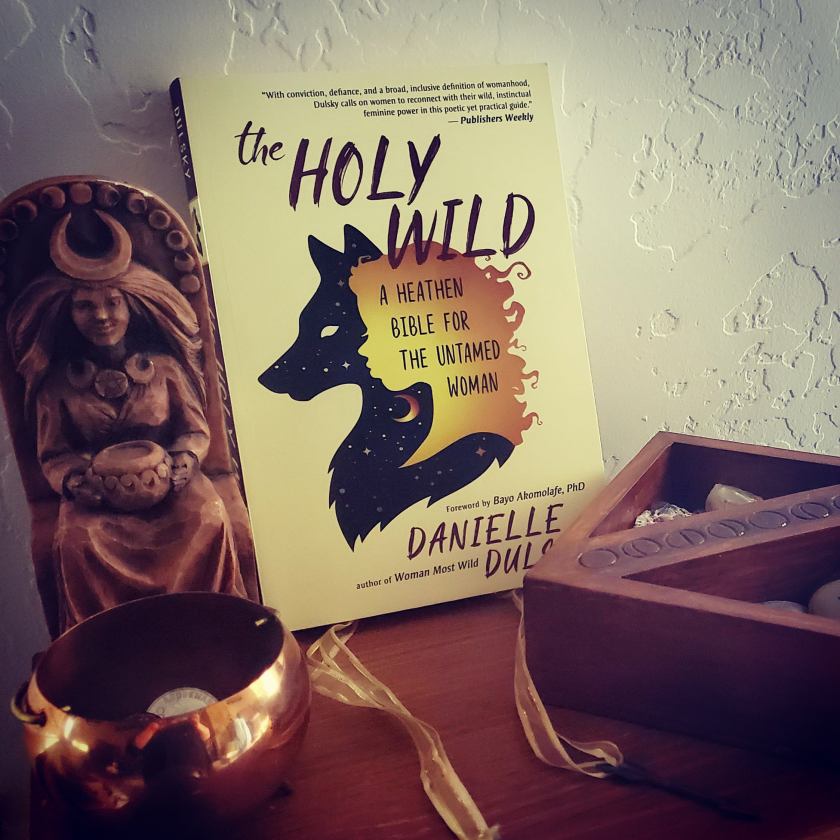
[Witchy Review] “The Holy Wild” by Danielle Dulsky

Full Title: The Holy Wild: A Heathen Bible for The Untamed Woman
Author: Danielle Dulsky
Published: September 2018 by New World Library
Genres: Nonfiction, Wicca, Gaia-based Religions, Comparative Religion, Spirituality
Edition Details: 304 pages, trade paperback
Source: Purchased
Rating: 3.5/5 stars

First Glance

To be candid, I bought this book based on the cover. My mate and I have matching hoodies with that wolf-woman image on it, and I couldn’t resist taking a closer look at a book with the same art on the cover. Since it was in the New Age section, I took a chance and grabbed it without looking up reviews or skimming the contents.

Positive Bits

Right off the bat, let me applaud Dulsky for how easily equality slipped into the story. Even though the title would imply this book is focused on cisgender folks, she immediately makes it clear (less than a dozen pages in) that she chose to emphasize the pronoun She/Her while seeing that divinity as “irrefutably pan-gender”. Again and again, she makes it clear that all feminine-leaning folk are welcome, regardless of physical form, to include mentioning their ability to use a Prayer for the Energetic Womb without having a physical womb (as it is about the energies of creation). This isn’t a common practice in books, which are either actively cisgender in their focus or passively so.

The writing portions throughout the book encourage you to write your own mythology, and to recognize the God-Goddess-Mystery within yourself in each story. As a writer myself, I find guided journaling to be an important tool for spiritual growth. The appendix at the end includes further questions and meditations to ponder, all of which fit in nicely with the path she outlines throughout the book.

I think there’s a lot of beauty in the poetic-prose Dulsky used to tell her tale. She built the book to be used out of order, and it shows in the way she allowed each elemental section to stand alone in its own story.

Less Enjoyable Bits

As someone who has never been a Christian, I have a hard time connecting to biblical stories. Unfortunately, the main myth that’s retold in each section is based on a feminine figure from the Bible. Salome, Mary Magdalene, Lilith – they all have interesting pasts and are retold with a beautiful shift to the focus of each story, but I’m not familiar enough with the Christian mythos to really connect with them on the level Dulsky likely hoped I would.

Another issue came in the form of an unexplained reference to “the Red Road”. After getting about 50 pages in, I finally looked onto for what she might be talking about. I assumed it was Christian, but it actually comes from a loose interpretation of various Native American beliefs. Considering how often it came up, I’m surprised to say she never explained it from start to end.

I don’t think this book is made to be read in one sitting. I read it all at once, and the poetic-prose became a little foggy after too much flowery imagery. If you read it in pieces over a few days, though, I think that’d be mellowed out to something more enjoyable.

Tidbits Worth Repeating

I am sucking the poison of patriarchy and privilege out of the soil and spitting it moonward, for these are the dire days of the fallen kings and raising queens. – page 44

There are few things in this world that cause more anguish than realizing that you are not who you thought you were, and, quite often, such a realization comes on the heels of a great wounding. The sword of the Dark Goddess hits us in the belly, the seat of our sense of self, and forces us to release the parts of our outward identities, the masks we show the world, that have become restrictive to our souls, the truest parts of ourselves. – page 130

The skeleton of any spell is formed from intention and energy raising, with its specific shape, the flesh laid over the bones, sculpted from the infusion of energy into the intention. – page 193

Is it worth the coin?

Yes(ish) – if you’re looking for a guide on exploring your ties to divinity and your personal mythos, I think this is a great starting point. If you’re looking to explore goddess worship, I’d find a simpler and more focused resource.

Posted in [witchy reviews]

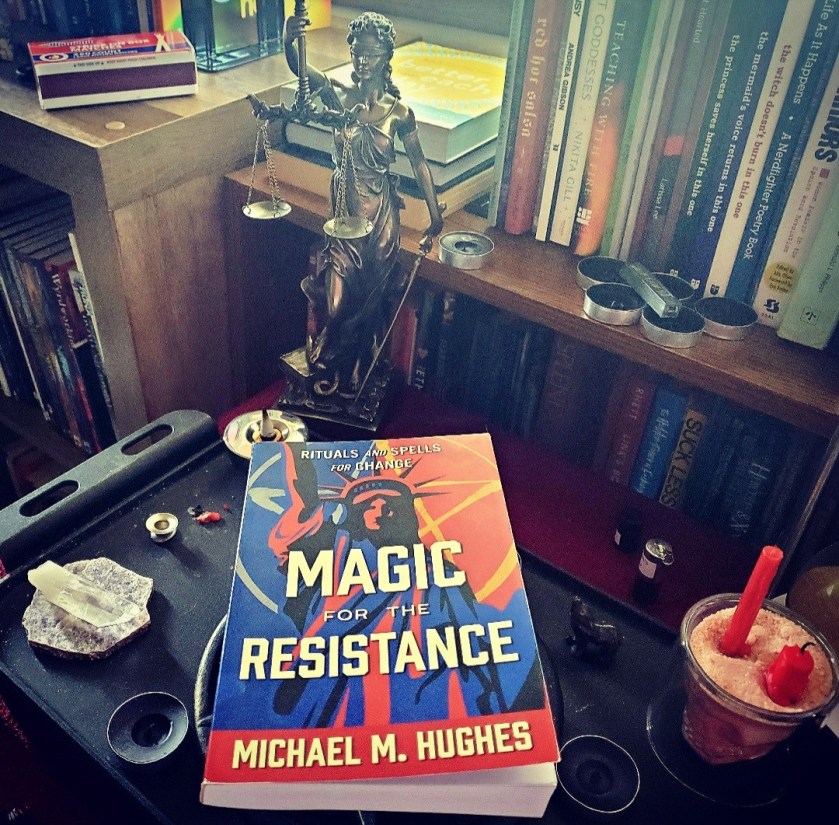
[Witchy Review] “Magic for the Resistance” by Michael M. Hughes

Full Title: Magic for the Resistance: Rituals and Spells for Change
Author: Michael M. Hughes
Published: September 2018 by Llewellyn Publications
Genres: Nonfiction, Human Rights, Magic Studies, Occult, Witchcraft
Edition Details: 264 pages, trade paperback
Source: Purchased
Rating: 4/5 stars

First Glance

In light of the social and political turmoil following George Floyd’s death, I mentioned to my wife that I had a list of witchy books related to activism and magic resistance. I had originally started a wishlist based on several Patheos posts. When she asked me why I hadn’t purchased any of them yet, I didn’t have a good reason. Half a dozen books were ordered immediately, and this was the first to arrive.

Positive Bits

To start, I appreciate the author’s choice to include a large section on the history of magic and activism before touching the magic itself. I think context is key to understanding magical workings, and the added knowledge gives additional strength to your magic. It was also interesting to note that he was the creator of the “Bind Trump” ritual that went around in 2017 and hit the major news networks. I had no idea!

The histories presented are done so in an entertaining and informative way, and I appreciate that sources are listed as footnotes. Some of the events are familiar, if only in a word-of-mouth kind of way; however, I like to look up details on events, particularly if they sound outlandish and have no specific sources.

In the section that includes spells and rituals for your magical activism, the variety provided allows for a “different strokes, different folks” approach. In fact, more of the rituals lean toward what I would call generally pagan or Wiccan-flavored than I expected, considering the author’s description of his own spiritual path and history. However, I found the less delicate options (like the spells “Calling Bullshit” and “Hex the NRA”) fit the more offense-vs-defense attitude the book seems to suggest. There’s a good balance.

I’ve personally set aside notes on a couple of projects for upcoming moon workings, so I definitely gained some ideas from this book that I didn’t have before. I’m glad this book was written to be so approachable, even from a non-witch perspective.

Less Enjoyable Bits

No book is perfect. I’ll admit that part of my issues stem from differences in paths. The author made it clear that he’s not a witch or pagan, but rather a magician with a relaxed attitude toward methods of magic. In some cases, you can see the ceremonial magician leanings, particularly when he tells you to do a thing, but then tells you “it just works, not sure why”.

When my previous training covered some basic ceremonial magic, we were told the same thing: if you follow the instructions, with or without belief, you will get the results. Actions matter more than intent. That never really worked for me, considering how often we’re told that intent matters more than tools, herbs, and stones – because we’re the source of magic, and they’re just a focus.

Unfortunately, the author gets a little preachy in the middle as he discusses “Self-Care and Resilience” and “On the Casting of Circles”. I don’t mind someone suggesting a no-kill fast for magical purposes, but implying that your magic will be negatively impacted by eating animals is a step too far. (To be fair, he does say to “trust your intuition and what your body tells you”.)

When we get to the section on casting circles, he dismisses the entire process without discussing the benefits of a circle; clearly, he has a hard preference for no circles in magic. He then immediately follows that dismissal with a watered-down ceremonial magic circle that takes up several pages of instruction, rather than anything familiar from witchcraft and circle casting methods in general. I feel as though the pages of complaint against circle casting are a product of the author’s experience in ceremonial magic and its structures. To each their own?

Tidbits Worth Repeating

A good rule of thumb to use is this: Would you endorse a legal action to stop the target’s harmful actions or policies (say, against a minority group, a forest, or a person unjustly accused of a crime)? If so, then a magical action is absolutely ethical. – Page 7

The more you do magic, the more possibilities you see for its use. Always look for ways to blend your magical workings with your practical activism. – Page 118

Now light a candle and get to work. – Page 222

Is it worth the coin?

Yes – I think this is a good place to start, if you’re wanting to use your magic as part of our activism. The overall accessibility of the spells and rituals makes it ideal for a beginner in this kind of work.

Posted in [witchcraft & wonder], [witchy reviews]

Ethics: Sex

This discussion and questions come from Chapter 7: Sex in When, Why… If by Robin Wood.

[Previous posts in this Ethics series are: Personal Ethics: an introduction, Ethics: Honesty, Ethics: Self, Ethics: Love, Ethics: Help, and Ethics: Harm.]

Introduction

Sex! Woohoo!

Sexuality is a complex topic. I personally believe that everyone lives on a four dimensional graph of possible sexual identities and preferences. In others words, there is no Type A, Type B, or Type C. We’re all different colors of humanity.

Rereading my answers to this chapter makes me giggle. I’ve redone them, though, to reflect the person I am now.

[1] My idea of perfect sex would be…

…love and fun! Why so serious?!

[2] My sexual bias is…

…complicated. Sex and love are very tied together for me, but gender doesn’t play a big role in that equation.

[3] My parent’s attitude about sex was… 

…prudish. They’re both very straight-laced, vanilla people. For their sake, I won’t go into any details; let’s just say that my mother and I discussed sexuality after I got married in my early adult years, and it’s the truth.

My dad hates homosexuality, or at least he did last I heard. I swung in the opposite direction, embracing equality and openness when I faced his closed judgement of others. My mom, on the other hand, has always said “whatever floats their boat” about the choices of others. She’s always been a good guide for me; I consider many of my personal ethics to have been directly molded by her attitudes.

[4] The part of sex I am most comfortable with is…

…kissing. Even when I was an inexperienced sexual noob, I enjoyed kissing. I’ve never felt lost or confused or intimidated by kissing. It’s also the most exciting lead-up activity for sex, in my personal opinion.

[5] The part of sex I am least comfortable with is…

…the first time with a new partner. I’m always afraid that they’ll be unimpressed, that the things I thought I did well before were just preferences of a previous partner (rather than generally-enjoyable activities for anyone). It’s intimidating to face a new person and not know what makes them tick.

[6] Sex is wrong when…

…anyone is coerced, forced, or under the influence. A drunk yes is still a no, in my book! Under-aged partners are a grey area, depending on age differences and laws; generally, I agree with the societal limits placed on these situations.

[7] Sex is right when…

…everyone is completely willing. Now, there are places and times where sex isn’t a good idea (i.e. at a playground, in the middle of the street, and so forth). Generally, though, these things are common sense.

[8] If I have sex with someone, it means…

…I love them and wanted to express it physically. I’ve never had sex with a stranger or someone I didn’t love; it’s always been friends or people who’d already entered into a relationship with me. There’s no such thing as a “friend zone” in my life, unless you mean the place I choose partners from!

That said, I don’t mean love as in commitment, devotion, and all that jazz. I mean my own definition of love: being happy when someone else is around me. So sex is an expression of that happiness. See [9] for more details.

[9] What makes sex a holy act?

I strongly believe that “all acts of love and pleasure are Her rituals”. Sex is an expression of love and joy, and I believe it pleases the gods when done without causing harm (see “Sex is wrong when…”). Sex can be used in magic, too, to raise some major energy; I don’t personally have the desire or focus to try anything like that right now, but it’s an intriguing subject to read about!

[10] Who benefits the most from sex?

Both parties (should) benefit from sex. It’s all about balance and fairness, in my book. Now, sometimes that means one person has an awesome time that morning, while the other gets some serious attention that night… but let’s not get too picky over the details.

Final Thoughts

Love and sex have been an area of personal growth for me these past few years. I went from being a monogamous straight girl to a polyamorous woman in the middle of a complex relationship web. I wouldn’t have it any other way!

Earlier today, though, it was funny to analyze myself and realize just how far from “normal” my life and relationships have shifted. If the Regulars in my life (coworkers, customers, etc.) caught a true glimpse of what I’ve got going on, they’d probably think I’d lost my mind. Again, I wouldn’t have it any other way. Who wants to be normal, anyway?

Posted in [witchcraft & wonder], [witchy reviews]

Ethics: Harm

This discussion and questions came from Chapter 6: Harm in When, Why… If by Robin Wood.

[Previous posts can be found here: Personal Ethics: an introduction, Ethics: Honesty, Ethics: Self, Ethics: Love, and Ethics: Help.]

Introduction

Harm is a hot topic in paganism overall. “An ye harm none, do what ye Will” is one of the most commonly mentioned ethical guidelines in most pagan circles, even if not all participants are Wiccan. And yet, the study of personal ethics is about looking beyond the black-and-white world of morality. It’s about taking responsibility for your own actions, good and bad.

Harm can be necessary. Surgery is harmful, but it can remove an appendix before it bursts. Telling someone a painful truth can hurt their feelings, but perhaps it saves them from a worse pain in the future. Even choosing not to take action can be harmful, as the bystander effect can lead to people watching a crime happen and doing nothing to save the victim or seek help. On the other hand, sometimes not taking action is the choice to allow a person to grow via the harm their current course of action is leading toward.

[1] Define Harm.

Any force that causes (i.e. forces) change is harm. It’s not necessarily good or evil, but generally it’s considered damaging.

[2] In what circumstances are you most tempted to harm someone else?

I’m tempted to harm someone if I see them try to harm a person I care about (myself included).

[3] In what circumstances are you most tempted to harm yourself?

I harm myself with internal dialogue. There is a reason they say “you are your worst critic.”

[4] Describe a situation in which it might be necessary to choose the lesser of two harms.

Eating vegan. I can choose to eat animal products, meaning that I contribute to the suffering of animals. Or I can choose to be hangry all of the time, as I can’t guarantee I’ve taken enough food to work to sustain me; there’s no option to just run out for a quick snack when you’re vegan.

[5] What would you do in this situation, and why?

I personally choose to eat. I have vegetarian foods here and there, but I’ve learned to accept that I’m not an herbivore, and people don’t like me hangry (myself included).

[6] How much force would you use in this situation, and why?

I would try eating as a vegan (part-time and full-time), try eating as a vegetarian, and then try randomly including vegetarian meals at home. I only try for a short period (a week or two) before stopping, because my health (mental, emotional, and physical) is more important to me than stressing over the state of the planet.

[7] Why should you avoid harming someone else, anyway?

If harm is forceful change, than harming someone is forcing them along (or off of) their path in life. You are not their god, you have no right.

[8] Why should you avoid harming yourself?

Self-harm is often toxic and unfair. You see curvy women as sexy and beautiful, but you call yourself a fat cow when you look in a mirror. You see other people with your sense of humor as being funny, while calling yourself annoying or stupid. Self-harm often comes from dishonesty, because you can’t objectively look at yourself.

[9] What should you do if you harm someone?

Apologize and fix it. Some things can’t be fixed, but even forceful change to a relationship can grow into something. You may fight with your bestie, then apologize and make up, but your relationship will forever be altered by that fight. You can’t ungrow or unbreak anything.

[10] How might you harm someone through inattentiveness?

When you ignore someone, you leave them feeling unwanted. Maybe it’s by accident, because life is busy and full and you’ve lost track of your own toes. They don’t know that; all they see is how little you call/text/come by for a visit.

Final Thoughts

My biggest concern with harm is the ability for us to break other people, emotionally. I’m sure you’ve felt it, too. There are moments when, as words come out of our mouth (in anger, in the heat of the moment, and so forth), we see a fork in our path; speak the harshest words, and you’ll slice a spirit and leave scars you can’t undo.

I’ve been guilty of this. Sometimes, it’s been self-defense. I found myself in a situation where I was being hurt by love that I couldn’t undo; loving someone broken leads to your own breaking. Hacking and slashing at them until they turned away from me was the only way I knew to get free of their grasp. I have to accept responsibility for the broken relationships I’ve created this way, including those I couldn’t repair with apologies or time apart.

I find myself often measuring my actions on a scale, trying to balance potential harms with potential growth. Sometimes, that means I charge in and blaze my own path; other times, that means I sit back and let an opportunity slide by. It all depends on what kinds of harm I think may come from my actions, both to myself and to others.

Posted in [witchcraft & wonder], [witchy reviews]

Ethics: Help

This discussion and questions come from Chapter 5: Help in When, Why… If by Robin Wood.

[Previous posts in this Ethics series include: Personal Ethics: an introduction, Ethics: Honesty, Ethics: Self, and Ethics: Love.]

Introduction

Help is an interesting topic for ethics. I’ve always been taught to give whatever help I could afford to give, especially to those I notice need it the most. My favorite quote in this book is about help as well, though it’s found in the chapter about Love:

It [Love] is the decision to give all that you can honestly give without begrudging it, whenever you are asked.

My work ethic comes from this idea. I will always strive to do as much as I can, for whomever I can, as long as it’s something that I won’t regret or begrudge. And, being the kind of person I am, I only require acknowledgement of my efforts to feel appreciated; I don’t need awards, parades, or special thanks. Part of how I express my love for humanity as a whole is by offering help whenever I can.

[1] Helping others means…

…providing whatever assistance they ask for and/or accept.

[2] Accepting help from others means…

…allowing those with skills, energy, and ideas to assist me when I can’t do something alone. Sometimes, it also means allowing someone else to do something I *can* do alone, if only to spread out my “to do” list and make life less hectic.

[3] I feel that I should help someone most when…

…they clearly want/need help. I feel the need to help if I see that someone is struggling, or if someone asks for help and doesn’t get it from someone else immediately (I’m not a bystander).

[4] I am most likely to ask for help when…

…I’m feeling overwhelmed or need a break. I don’t often try things I can’t do on my own, but I have a bad habit of over-scheduling myself or writing epic TO DO lists that leave no room for eating, sleeping, or breathing.

[5] I should offer to help if…

…someone appears to need something I can provide.

[6] If someone refuses my help, I…

…let them know my offer stands, then back off. I don’t like pushy people, so I don’t get pushy with others.

[7] I am most likely to refuse to help, even if someone asks, when…

…that person never approves of whatever I’ve done once I’ve helped, even if I’ve followed their directions exactly. Nit-picking makes you no friends!

[8] I am most likely to refuse the help of others when…

…that person has frustrated me by ignoring previous requests for help. Like I said, it’s usually a bullet point on a long “to do” list, rather than something I can’t actually do myself. If I asked for Person A to take out the trash (twice) and got no help, I’m going to refuse help with dinner, dishes, laundry, and just about everything else. It’s like an angry-cleaning-protest thing I do.

[9] Offer your help to someone. Pick someone you think will be likely to take you up on it. If they refuse, offer to help someone else. Keep going until someone accepts. When they do, be “good help.” Write down who you asked, what they needed, what you did, and how you felt about it.

I don’t get many chances to change up my routine, so I used work. I know Shannon’s just as frazzled as I am, so I asked if she neede help. She had a list that needed to be done, so I completed parts A and B (as requested) and brought it back. It felt good, because she was relieved to cross something off of her work “to do” list.

[10] Ask someone else for help. Pick someone you think will be able to give it. If they can’t, ask someone else. Keep going until someone accepts. Write down who helped you, what you asked for, what they did, and how you felt about it.

I have no examples of this. At work, I’m the helper, not the helpee; I’m the go-to girl, because I work faster and more accurately than anyone else in my department. At home, I’ve gotten into the habit/routine of asking others to take a turn at dishes, laundry, and the like. Life is too basic and patterned to really have opportunities to do anything additional.

Final Thoughts

After reviewing my answers from previous years, I’ve found that I’ve grown a bit in this area of ethical behavior. I used to have a problem with pushing myself to the limit, and I’d end up begrudging others for not offering help (even though I never asked for it and pretended to be completely self-reliant). Now, I’m in the much better habit of asking for help when I feel it would be beneficial, even if I could *technically* complete my tasks alone. It’s better to let others help than to be angry at them for my own refusal to ask.

Posted in [witchcraft & wonder], [witchy reviews]

Ethics: Love

These questions are found at the end of Chapter 4: Love in When, Why… If by Robin Wood.

[Previous posts in this Ethics series include: Personal Ethics: an introduction, Ethics: Honesty, and Ethics: Self.]

Introduction

Love is an important topic to me, at least for my spirituality. Almost four years ago, I found myself experiencing polyamory in an enormous spurt of personal growth. I not only loved more than one person, but I loved big and strong and unfettered. I found myself unable to see love as a one-to-one measurable thing, like society had taught me; instead, I was enamored with life and people and the Universe at large.

Love comes in so many shades and nuances. I love my best friend as a sister, because our personalities meld naturally. I love the men in my life, because they fill parts of myself and help me find purpose. I love others based on parts they play in my Big Story, even when their part is harmful to my short-term self. Even those who interact with me with violence and hate have my love; they push my toward growth, and I can’t help but love them for it.

[1] When someone tells me they love me, I think they mean…

…that they feel happiness in my presence.

Obviously, different people will feel different levels of love in that sense. However, I believe love is all about finding happiness in the presence of others. That’s why I embraced polyamory (many loves) so readily; I was born to love big.

[2] I react to this by…

…feeling happiness that I cause them happiness.

I like to feel like a positive influence in someone else’s life. It doesn’t matter what level of influence I hold; what matters is that it’s positive enough to be vocalized and valued by the person experiencing it.

[3] When I tell someone I love them, I usually mean…

…that they make me happy.

I share the words “I love you” openly, far more so than I was taught as a child. I say them to family, friends, lovers, and even acquaintances when it feels right. Sometimes everyone just needs a moment to be loved, and I have no problem with voicing my happiness at their existence.

[4] I expect them to react by…

…understanding what I mean.

Generally, I measure my proclamations of love against the relationship we have and decide if they’d understand that “I love you” isn’t a commitment, a trap, or anything binding. It’s just an expression of the joy they create in my life. If that may be misunderstood, I’ll use some other way (rather than the words) to express how that person makes me feel.

[5] I have no trouble believing that others love me. True or False?

True!

[6] This is because…

…I was lucky enough to be raised in a loving household. I’ve felt lonely and lost many times in my life, but I’ve always known I’m lovable (even if I’m not currently feeling loved). There’s also this ridiculously objective part of me that labels my good traits as love-worthy and refuses to let me feel unlovable.

[7] I am comfortable/uncomfortable with this because…

…I’m comfortable, because I think it’s healthy to know you’re lovable, especially when it seems like no one in your life is actively in love with you. You need to love yourself and know yourself to be worthy of love.

[8] I want to change/don’t want to change the way I think about love, because…

…I don’t want to change, because (again) I think I have a healthy outlook. I’m a well-adjusted adult who feels love, shares love, and enjoys love.

[9] When Robin tells us to love everyone, she means…

…that everyone is worthy of love in some form. Love doesn’t have to be tied into lust, commitment, or other feelings. Sometimes you can just love someone for existing, as they play a part in the Big Picture of the universal design. Even the assbutts play their part by reminding you to not be an assbutt.

[10] I think I can/don’t think I can do this, because…

…I think I can do this, because I’ve made it a personal mission to demonstrate patience and love of humanity toward strangers. I want to be the light I wish to see in the world, and I hope it rubs off on people.

Final Thoughts

We had an interesting debate in class on this topic. Do you have to love people who do only negative things in their lives? If you believe that loving everyone (in some way) is necessary as part of the Universal Balance, then you can’t pick and choose; that means you would have to love both Hitler and your mother, the rapist and the Dalai Lama. Everyone, good and bad, plays a part in the Big Picture. Balance requires it.

It’s just an interesting thing to ponder. After all, it’s one thing to speak of loving humanity and seeking balance… it’s a whole ‘nother thing to actually accept that love into yourself.

Posted in [book reviews], [witchcraft & wonder], [witchy reviews]

Ethics: Self

The following questions and discussion cover Chapter 3:Self in When, Why… If by Robin Wood.

Introduction:

[See Personal Ethics: an introduction and Ethics: Honesty for the previous entries in this series.]

I love how hard this chapter is! It makes you look at yourself (with honesty) and realize how your choices and actions affect others, as well as yourself. Even now, looking at my answers from a week ago, I’m starting to question my self-assessment.

First, let me define a couple of things for those without the book. A Mego is someone who’s ego makes everything about them (i.e. “me me me”). An AntiMego is someone who always puts others first, sometimes to their detriment (i.e. “give until it hurts”). A balanced person may swing slightly between these two personality types, but they avoid the extremes on either end of the spectrum.

In my answers, I call myself a mild Mego. I originally based this rating on the fact that I’ve been very forceful lately, both with myself and those around me. My inner dialogue is less “but how will this make him/her feel?” and more “he/she will survive if I do this the way I was planning to”. At the same time, however, I recognize that I still put other people’s feelings and needs above my own regularly.

For example, my coworker gave incorrect information this morning. The Mego in me didn’t correct her, because I don’t enjoy her acidic attitude (she doesn’t take any form of criticism, constructive or not). I contacted our supervisor to ask for assistance, because she can correct my coworker without getting any lip in the process. The AntiMego in me contacted our supervisor for assistance, because I didn’t want her to continue making errors that affect her students, but I also understood that she wouldn’t handle my correction well. I didn’t want her day to be shot and tension to rule our office for the entire shift. Depending on how you view the situation, I acted either as a Mego or AntiMego.

As always with ethics, nothing is ever cut-and-dried.

Now, on with the chapter’s exercises!


[1] On the Mego-AntiMego continuum, I feel that I usually act like…

…a 4.9M, close to midrange but not perfectly balanced (and slightly more Mego than AntiMego).

[2] I say that because…

…I’ve been pushy lately with my wants, needs, and goals. I’ve accepted very little in the way of compromise, largely (I think) as an overreaction to being too flexible and willing in previous years.

[3] I want to change/don’t want to change because…

…I’m good where I am. I’ve always been midrange and almost balanced, and I think different parts of our lives deserve different levels of self-focus and selflessness. As long as the balance isn’t thrown into a huge pendulum of extremes, I think it’s all good.

[4] An honest, balanced self image would include…

…recognizing both your faults and your gifts without giving more weight to one or the other. Let each thing, good or bad, be measured on its true merit and not perceived value. For example, having a skill at creative writing is not less useful than the skill of cooking. Sure, cooking will actually feed a family and so forth, but a story will feed minds. Murderous rage is obviously a bigger flaw than biting your nails.

[5] Write a list of your best character traits; those things that you would love if you found them in someone else. Make sure there are at least ten things on your list.

I’m creative. I’m great with random facts. I say the weirdest things for a good laugh. I have a way with words that gets people to truly listen. I can cook randomly delicious meals out of miscellaneous pantry items in a pinch. I’m not dramatic. I enjoy simple pleasures, like movie night with friends. I don’t belittle or look down on others for not knowing something, because there are no stupid questions. I enjoy helping others. I love with an open heart.

[6] Write a list of things about yourself that you would like to change. Put no more than three things on your list.

I want to stop being a procrastinator, especially of my own dreams. I want to push myself to learn new things, even when I’m comfortable right where I am. I want to learn to let go better, so I can enjoy certain songs/smells/tastes again without negative memories clouding my enjoyment.

[7] If you pegged yourself at 3 or below, do something for someone else that can not possibly help you, every single day this week. If you are 7 or above, do something for yourself that can not possible help someone else, every single day tihs week. If you are between 3 and 7, decide which of these exercises you would get the most good out of, and do that. Or do some of both!

It’s hard to do this exercise for two reasons. One, I always forget it’s here until halfway through the week when I actually get to these questions. And two, I’m already a midrange person, so I already make a habit of balancing between myself and others. My biggest change is making an effort to do nice things that are out of the usual pattern, like washing and folding up all of the laundry myself instead of splitting the chore or cooking dinner without help.

[8] See all the clerks, waitresses etc. that you encounter today as real people, with their own lives, and their own stories to tell. Really look at them. Acknowledge them as people.

I’ve seen workers as people since my first job in high school. It’s hard to judge someone harshly when you’ve walked in their shoes and been just as underpaid and undermotivated. This lesson has never left me, and even the worst waiters and rudest clerks get treated as people.

[9] Treat everyone sharing the road with you today as if they were real people in cars of their own, with destinations as important to them as yours are to you. If someone cuts you off in traffic, say a prayer for their safety and that of everyone they encounter as they hurry to their goal.

I don’t suffer from road rage. My reaction to being cut off is “hey, be careful!” My usual passengers can attest to the fact that, after a near accident, I pray that person drives much more cautiously after escaping our near-crash. I’ve been laughed at for being too kind, but it falls into the same category as [8]. I can’t not see people as people, and I’m careful about throwing negativity around all willy-nilly.

[10] Do something spectacularly nice for someone in your family, just to surprise them. If you rated yourself as an 8.5 or above, then the person in your family to “treat” is you!

I’m going to do some serious cleaning this weekend (before class) to treat everyone else in the house. Normally, we scrape by with minimal cleaning (dishes, laundry, and trash) and nobody wants to touch dusting, sweeping, clutter, etc. Occasionally, I choose to do so in an effort to make everyone feel uncluttered and tidy.

[Note: I did do some cleaning, mostly of the living and dining areas. Everyone was pleased!]


Conclusion:

Everyone goes through phases of Mego and AntiMego in their life. It’s natural and (within a certain range) acceptable. The key is finding balance in your daily life, and learning to expand beyond your natural state when necessary. There’s nothing wrong with being a Mego, as long as you’re willing to step down and not be the most important thing in the room when it counts.

Posted in [book reviews], [witchcraft & wonder], [witchy reviews]

Ethics: Honesty

The following questions were found at the end of Chapter 2: Honesty in When, Why, If by Robin Wood.

[1] Define honesty.
Honesty is the truth in whatever package it is delivered (tactful or not). It’s a matter of honor, in
my eyes, because your word is your power (and a liar’s word is worthless).

[2] The thing I am most likely to be dishonest with myself about is…
…hard to pinpoint.

Originally, I thought that I lied to myself about my emotions. After careful review, I realize that I
don’t lie about them at all; instead, I simply choose not to act upon them if inconvenient.

Instead, I think I lie to myself about how much someone else will be affected by my emotions
(or lack thereof). I tell myself that my friend is better off not knowing how I feel about them or
their choices, even if the truth is that I’m more comfortable (read: complacent) with telling them
nothing and avoiding conflict.

[3] When I am dishonest with myself it is usually because…
…I’m tired.

I feel like I’m bone-deep tired of humans. It’s silly, I know. But sometimes I feel like all of the
drama and intrigue and conflict is infectious and beneath me. I notice myself internally sneering
about something, and then I cringe as I recognize the judgment expressed by that feeling. I keep
it to myself, because I don’t want to deal with conflict (even if it would easily be resolved).

[4] I have no problem being honest with myself about…
…my goals, wants, and needs. I’ve come a long way here. Something in my clicked, and I
suddenly knew with extreme clarity just what I wanted from life this time around.

[5] I can talk to anyone honestly about…
…opinions based in fact or study.

I can talk politics, religion, and sex with anyone, as long as respect is present. I don’t mind
differing opinions; in fact, I tend to thrive in them. You learn so much looking at life from a
stranger’s point of view. My only issue is when respect leaves a conversation; then, so do I.

[6] At the moment, I would rate my self-honesty as ___ on a scale of 1 to 10, with 1 being
constantly lying to myself, and 10 being completely and objectively honest with myself.
8-9

[7] I would give myself this rating, because…
…when I review how I communicate with myself, I see very little deceit. It pleases me to see my
own internal honesty, even if it doesn’t always manifest for others in my expression.

[8] In a year, I would like to be ___ on this honesty scale.
8-9

[9] I am trying for this much progress because…
…maintaining personal honesty is a good goal. I’d like to work on my ability to be honest with
others more, though. I’ve started this process by voicing my concerns and opinions to those I
speak to regularly, making sure I don’t keep my mouth shut to take the easy path.

[10] Honesty is important because…
…from honesty grows trust, respect, and love. It’s the foundation.

Feel free to share your thoughts or questions below!

Posted in [book reviews], [witchcraft & wonder], [witchy reviews]

Personal Ethics: an introduction

Go read “When, Why, If” by Robin Wood.

Now.

Okay, you read it right?

Well, that book is one of my favorites for spiritual growth and personal development. While it was written for pagan people, I think that almost anyone could find a great depth of knowledge and insight into themselves (and their spirituality) by reading it.

The book covers ethics, ranging in topics from Honesty and Love to Harm and Help. It talks about how ethics aren’t concrete like morals. While a moral tells you “do this, don’t do that”, ethical behavior is about following less strict guidelines while measuring each situation for its best solution.

Nothing is ever cut-and-dried.

Should you steal? I’m guessing you’d say no. What if you were starving? What if you had three kids and the local shelter was closed for the night and none of you had eaten in days?

Should you kill? Traditionally, we’d say no. But we amend that moral with “unless it’s self-defense.” As a society, we’ve decided to allow for the right to protect your own life by taking someone else’s. However, it can get muddy. What if you simply “felt” in danger? What if that boy in the hoodie looked dangerous, looked like trouble, and you decided to remove him before any injury could occur? Is that self-defense? [Note: Yes, I’m referring to Trayvon Martin or any other young, dangerous-looking boy walking through the wrong place at the wrong time.]

Should you lie? White lies are considered part of being tactful; after all, no one likes the assbutt who constantly tells people they look like fat cows or smell like a gym sock (even if he’s telling the truth). We, as a society, don’t like rude people. However, we don’t like liars either. Is it okay to lie to get into office? What if you lie by omission, rather than outright lying to someone? Lies break trust, so the more often you lie the more you wittle down the amount of trust people feel toward you.

Ethics have no straight lines. In fact, I’d say ethics are a bit wibbly wobbly, timey wimey at the core. No two people will feel the exact same way about every situation.

A perfect example would be me and my friend Sarah. When a man almost t-boned us on the way to work one morning, we had two completely different reactions. I wished hard that he would be scared into driving safely for weeks after our near-miss. She wished just as hard that he’d find his car wrapped around a pole. I don’t believe in wishing harm on others, because thoughts are energy. Sarah doesn’t feel that her thoughts hold any more power than a middle finger raised in his rearview mirror, so she feels no qualms about hoping his day ends violently. We are like sisters, but we are not always the same. Again, ethics are personal.

My blog will have random posts for the next few weeks. I’ve decided to share my answers to the workbook questions found in “When, Why, If”. I’ve always been a bit of an open book, and maybe you’ll glean something from my thoughts.

Feel free to ask questions!

Posted in [book reviews], [witchy reviews]

Magic is about manipulation?

“Magic, at its core, is about manipulation and directly attempting to make something happen. Whether it’s to heal or hurt, bind or repel, create or destroy, magic is a process by which the manipulation of either the spiritual or mundane world occurs.” – page 60 “Hellenismos Today” by Timothy Jay Alexander.

He goes on to say that Pagans show great hubris in believing they control or hold power over anything, and that everything happens as part of the Gods’ will.

I have to start off saying that I enjoyed (and devoured) his book, and I’ve started reading “Beginner’s Guide to Hellenismos” as well. But that said, I have to point out a few flaws in Mr. Alexander’s arguments (and writing…)

First, I can’t stand when someone repeats the same argument point over and over. On several occasions (as in mentioning the hubris of Pagans), he makes a point only to repeat it word-for-word on the next page. Having someone help edit his work may have avoided that issue. He also makes an unfortunate habit of claiming no disdain for a group (Pagans, Christians, etc.) only to turn around and bash said group for the next two pages. He comes off as the type of person who, in a face-to-face conversation, would make me walk away to avoid bumping into the brick wall of his “authority” over and over… and over… and over…

But the quote above had me thinking… how would I defend myself from such a claim? Can I? I spent my lunch break (and laundry time after work) examining my personal beliefs and practices, and I have a rebuttal.

As a Pagan, I do practice magic, though rarely. I find that prayers come first, because often I’m not in need of something specific (“I need money to get that operation.”) so much as something for my general well-being (“Please help me make tomorrow a better day.”) But I do practice magic, hubris-free.

Mr. Alexander says that a Hellenismos will write down a prayer, read it aloud to their deity, burn it, and then burn some incense or other offering in honor of that deity. In doing such a devotion, they please that deity and often it will in turn grant their desire (if reasonable… and yes, I know using “it” to talk about deities might feel weird… but it’s unisex!).

My personal belief is as such: When I cast a spell, I pull together my personal energies and those of elements around me and send them out with my desire. Often, my spells include a prayer to a deity; as I’ve always been most attracted to the Greek pantheon, it’s usually a Greek god or goddess. I also light incense, or a candle, as a focus and as a carrier to send my energies out to do their task.

But in my personal beliefs, we all send energies toward “the Universe” (capital U) with the understanding that It will determine what’s best for the good of all and grant us success or failure as necessary. The Universe may even let something bad we’ve cast fall back on us, as a lesson. But when the Universe is capitalized, it is like the Ultimate Divine Source. We cast our energies out to the Source with our intentions, when the Source sends back the results (success, failure, karmic ripples, etc.).

And when you or I use a specific deity’s name in our spells and prayers, we are essentially asking that particular deity to take notice. (In this, I agree with Mr. Alexander that Pagans as a whole often fail the gods in using them for a spell because they fall into a useful archetype.)

So, all in all, I guess I’m saying that my spells may be more empowered than a Hellenismos prayer, and I may be more focused than theirs. But I believe the Gods (whichever you believe in, all as One or as individuals) determine our magical “power”. They would not let us overpower Them; They are Gods. Duh. It’s not hubris to think that I’m an empowered worshiper, free to make moves with the essences around me and in me, to try and achieve what I desire. My gods will stop me or teach me a very painful lesson (or both) if I overstep. And I acknowledge that. If anything, I am empowered by my gods.

For anyone interested in modern Greek religious reconstruction, Timothy Jay Alexander’s books are a good place to leap from. His book for beginner’s is better than “Hellenismos Today”, as the first is like a rough draft version of the second (as though he published one, felt it was lacking in information, and went back for a second edition). And you’ve been warned, you prideful Pagans, that you’re full of hubris and need to be more respectful. /glare/